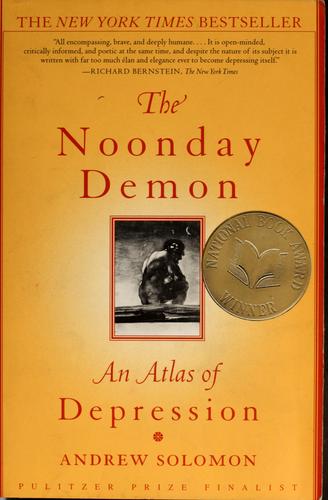
The Noonday Demon by Andrew Solomon is a 2001 health book about depression, mental health, treatment. Depression is not sadness but a different state entirely — an inability to feel, want, or anticipate, often accompanied by physical sensations of weight and paralysis that are as real as any organic disease.
Summary
The Noonday Demon is Andrew Solomon's exhaustive, literary account of depression — his own experience of it, its science and treatment history, its cultural and political dimensions, and the lives of people living with it across the world. Published in 2001, it won the National Book Award and remains the most comprehensive single work on depression available to a general reader. At 700 pages, it is not a quick read, but its ambition is matched by its achievement: to describe depression from every possible angle simultaneously.
Solomon begins with his own severe depression, describing the experience with precision rare in mental health literature — the physical weight of it, the way it collapses the future, the animal confusion of a mind unable to recognize itself. He had successful electroconvulsive therapy after multiple medication failures, and his account of ECT is particularly valuable for reducing the stigma attached to a treatment that is both more effective and more commonly feared than it deserves.
The book's subsequent chapters cover the history of depression's treatment, the neuroscience of mood disorders, the pharmaceutical industry's role in shaping treatment, the political economy of mental health care, the relationship between depression and creativity, alternative treatments, poverty and depression, and depression across cultures. Solomon interviews hundreds of people — patients, researchers, clinicians, politicians, and family members of those who died by suicide — and synthesizes an enormous literature with unusual care. His style is aphoristic and precise; individual sentences carry the weight of a careful essayist.
What makes The Noonday Demon unlike other depression books is its refusal to reduce the condition to a single explanation or prescription. Solomon is as interested in the philosophical and existential dimensions of depression — what it means, what it reveals about the limits of the self — as in its neurobiology or treatment algorithms. The result is a book that takes depression seriously as both a medical condition and a human experience, without collapsing either dimension into the other.
Talk to The Noonday Demon like its author wrote you back.
Get the ideas that fit your life — not generic summaries.
- Chat with the book
- Audiobook-style main ideas
- Adapts to your life and goals
- Helps you take action
Key takeaways
- 1.
Depression is not sadness but a different state entirely — an inability to feel, want, or anticipate, often accompanied by physical sensations of weight and paralysis that are as real as any organic disease.
- 2.
No single treatment works for all depressions: Solomon's own response to multiple antidepressant failures and eventual ECT success illustrates how individualized the treatment journey must be.
- 3.
ECT (electroconvulsive therapy) is one of the most effective treatments for severe, treatment-resistant depression, with a better safety record than its popular portrayal implies.
- 4.
Depression has biological, psychological, and social components that cannot be cleanly separated; the most effective treatment typically addresses all three dimensions.
- 5.
Poverty and depression are deeply intertwined: the chronic stress of material insecurity, social marginalization, and lack of agency produces depression at high rates, and depression compounds the barriers to escaping poverty.
- 6.
Creativity and depression have a historically documented relationship, but depression's creative benefits are retrospectively romanticized — the actual experience of depressive episodes is nearly always destructive to creative output.
- 7.
Depression's cultural expression varies dramatically: the somatic presentations common in non-Western countries (physical pain rather than psychological distress) suggest that how depression manifests is shaped by cultural scripts about acceptable suffering.
- 8.
Recovery from severe depression is possible and does not require returning to a pre-depression self — many survivors describe becoming, after treatment, someone different from who they were, in ways not entirely bad.
Discussion questions
Use these on your own, with a book club, or as chat starters in Superbook. Book club version, ready to copy or print →
- 1.
Solomon describes depression as an inability to feel, not as intense sadness. Does that distinction match any experience you've had or observed in others?
- 2.
He had ECT after multiple medication failures. The procedure has enormous stigma. Has reading his account of it changed how you think about it?
- 3.
The book covers depression across cultures and economic classes. What does its prevalence in people experiencing poverty tell you about the social determinants of mental health?
- 4.
Solomon argues that creativity and depression are associated but that the depression does not produce the creativity — the underlying temperament does both. Is that distinction convincing?
- 5.
The book is 700 pages about a single condition. Is that kind of exhaustive literary treatment possible for topics other than mental illness? What does the length suggest about what the subject requires?
- 6.
He covers the pharmaceutical industry's influence on depression treatment research. How should patients navigate treatment decisions in a context where the evidence base is partially shaped by commercial interests?
- 7.
Solomon writes as a patient, journalist, and intellectual simultaneously. Does the layering of those roles produce insights that a single-role account couldn't?
- 8.
He covers the political economy of mental health care — the way insurance, poverty, and access shape who gets treated. What would more equitable mental health care require?
- 9.
The book was written before social media. How would Solomon's account of social connection, isolation, and depression look different if written today?
- 10.
Recovery from depression, in Solomon's telling, involves becoming a different person. Is that a comforting or frightening prospect?
- 11.
He covers depression in children and the specific challenges of treating mood disorders before the brain has finished developing. How does knowing that childhood depression has long-term consequences change how you think about children's mental health?
- 12.
What is the most important thing you want people who haven't experienced depression to understand about it after reading this book?
Themes
Frequently asked questions
-
Is The Noonday Demon only about depression as personal memoir?
No — the personal memoir is the entry point, but the book covers neuroscience, treatment history, political economy, cultural variation, alternative medicine, poverty, creativity, and suicide in systematic chapters. It is encyclopedic rather than primarily personal, though Solomon's voice and experience are present throughout.
-
How long is The Noonday Demon?
Approximately 700 pages in the original edition, making it one of the longest popular books on a single health topic. Many readers read it in sections over weeks. It is the kind of book worth owning rather than borrowing because it rewards returning to.
-
Does The Noonday Demon give practical advice for treating depression?
It covers the full spectrum of treatments in detail — medication, therapy, ECT, alternative approaches — but it is not a how-to guide. The practical value is in understanding the landscape of options and the experience of navigating treatment, rather than a protocol to follow.
-
Is The Noonday Demon appropriate for someone currently depressed?
With care. The book's scope and length may be overwhelming during an acute episode. The personal sections and survivor accounts may be both comforting and difficult. It is probably more useful in a stable phase when you want to deeply understand the condition than during a crisis.
-
Who should read The Noonday Demon?
Anyone who wants the most comprehensive literary and scientific account of depression available. Essential for mental health professionals, researchers, and people writing about mental health. Valuable for anyone who has experienced depression or loves someone who has. Not a quick read, but unparalleled in its ambition and execution.