Talk to Free to Focus like its author wrote you back.
Get the ideas that fit your life — not generic summaries.
- Chat with the book
- Audiobook-style main ideas
- Adapts to your life and goals
- Helps you take action
Free to Focus, in detail
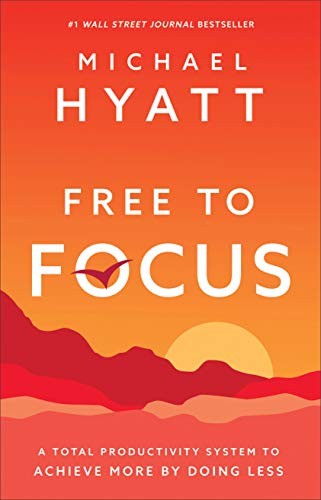
Free to Focus is Michael Hyatt's productivity framework for high-achieving professionals who feel perpetually busy but not meaningfully productive. Hyatt, a former CEO of Thomas Nelson Publishers and the founder of a leadership coaching company, built this framework from years of consulting with executives who had no shortage of activity but struggled to move their most important work forward. The book is organized around three phases: Stop, Cut, and Act.
The Stop phase challenges the assumption that working more hours is the path to better results. Hyatt argues that most people have never clearly defined what productivity actually means to them — they default to clearing inboxes and attending meetings because those tasks are legible and satisfying in the short term, even when they produce no lasting value. His concept of the "freedom compass" maps tasks along two axes: passion and proficiency. Work that falls in the high-passion, high-proficiency zone he calls the "desire zone"; work that is low in both he calls the "drudgery zone." Most people's goal should be to spend more time in desire zones and systematically exit drudgery zones.
The Cut phase covers elimination and delegation. Hyatt gives concrete frameworks for stopping activities that don't need to be done by you, automating repetitive tasks, and delegating systematically rather than ad hoc. He addresses the psychological resistance to delegation that affects many high performers — the belief that no one else can do it as well, the difficulty of letting go of visibility — and offers reframes for each.
The Act phase builds out a weekly planning system and a daily task management approach designed to protect deep work time. The system is explicit about batching meetings, creating themed days, and building margin into a schedule rather than filling every slot. The book is most useful for professionals with meaningful control over their calendar, and less applicable to people whose schedules are largely dictated by others. Hyatt's faith background surfaces occasionally in the text, which some readers will find resonant and others will find distracting.
The big ideas
- 1.
Most professionals have never defined what productivity means to them. Defaulting to inbox-clearing and meeting attendance is not a strategy — it's drift.
- 2.
The freedom compass maps tasks by passion and proficiency. Work in the high-passion, high-proficiency 'desire zone' should be protected and expanded; drudgery-zone work should be eliminated or delegated.
- 3.
Desire zone work is not always easy or comfortable, but it is the work where your energy and skill converge — where you are most irreplaceable and most motivated.
