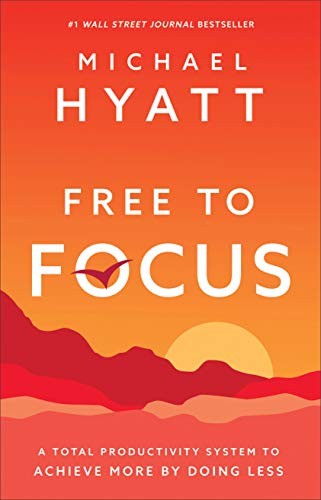
Free to Focus by Michael Hyatt is a 2019 business book about productivity, focus, goal-setting. Most professionals have never defined what productivity means to them. Defaulting to inbox-clearing and meeting attendance is not a strategy — it's drift.
Summary
Free to Focus is Michael Hyatt's productivity framework for high-achieving professionals who feel perpetually busy but not meaningfully productive. Hyatt, a former CEO of Thomas Nelson Publishers and the founder of a leadership coaching company, built this framework from years of consulting with executives who had no shortage of activity but struggled to move their most important work forward. The book is organized around three phases: Stop, Cut, and Act.
The Stop phase challenges the assumption that working more hours is the path to better results. Hyatt argues that most people have never clearly defined what productivity actually means to them — they default to clearing inboxes and attending meetings because those tasks are legible and satisfying in the short term, even when they produce no lasting value. His concept of the "freedom compass" maps tasks along two axes: passion and proficiency. Work that falls in the high-passion, high-proficiency zone he calls the "desire zone"; work that is low in both he calls the "drudgery zone." Most people's goal should be to spend more time in desire zones and systematically exit drudgery zones.
The Cut phase covers elimination and delegation. Hyatt gives concrete frameworks for stopping activities that don't need to be done by you, automating repetitive tasks, and delegating systematically rather than ad hoc. He addresses the psychological resistance to delegation that affects many high performers — the belief that no one else can do it as well, the difficulty of letting go of visibility — and offers reframes for each.
The Act phase builds out a weekly planning system and a daily task management approach designed to protect deep work time. The system is explicit about batching meetings, creating themed days, and building margin into a schedule rather than filling every slot. The book is most useful for professionals with meaningful control over their calendar, and less applicable to people whose schedules are largely dictated by others. Hyatt's faith background surfaces occasionally in the text, which some readers will find resonant and others will find distracting.
Talk to Free to Focus like its author wrote you back.
Get the ideas that fit your life — not generic summaries.
- Chat with the book
- Audiobook-style main ideas
- Adapts to your life and goals
- Helps you take action
Key takeaways
- 1.
Most professionals have never defined what productivity means to them. Defaulting to inbox-clearing and meeting attendance is not a strategy — it's drift.
- 2.
The freedom compass maps tasks by passion and proficiency. Work in the high-passion, high-proficiency 'desire zone' should be protected and expanded; drudgery-zone work should be eliminated or delegated.
- 3.
Desire zone work is not always easy or comfortable, but it is the work where your energy and skill converge — where you are most irreplaceable and most motivated.
- 4.
Delegation is not a shortcut. Done well, it develops people, creates leverage, and returns time to your highest-value contribution. Done poorly, it creates more work than it saves.
- 5.
Themed days — designating different days for different types of work — reduce the context switching that degrades performance and energy.
- 6.
Margin is not inefficiency. Scheduling buffer time deliberately produces better decision-making, fewer errors, and the capacity to respond to real opportunities as they arise.
- 7.
Rejection of a task or meeting is not laziness — it is a recognition that saying yes to one thing is always saying no to something else, and the implicit trade-off should be made explicit.
- 8.
Weekly planning that connects daily tasks to annual goals is the mechanism that translates aspiration into action without requiring willpower at every step.
Discussion questions
Use these on your own, with a book club, or as chat starters in Superbook.
- 1.
Hyatt's freedom compass maps tasks by passion and proficiency. What is currently in your desire zone, and how much of your actual week does it occupy?
- 2.
What would you need to stop doing — or stop doing yourself — to get more time in your desire zone? What makes that hard?
- 3.
The book argues that most people default to visible busy work because it is psychologically satisfying in the short term. Where do you recognize that pattern in yourself?
- 4.
Themed days reduce context switching. Is your current role structured in a way that could support themed scheduling, or do external demands make that unrealistic?
- 5.
What is one recurring task in your week that you could eliminate, automate, or delegate if you committed to it? What's stopping you?
- 6.
Hyatt argues that margin is a strategic asset, not wasted time. How much margin does your typical week have, and what does having too little of it actually cost you?
- 7.
The book is aimed at professionals with meaningful control over their schedules. If you work in a context with less autonomy, which ideas still apply, and which don't?
- 8.
Think about the last time you felt genuinely productive — not just busy, but like you'd moved something important forward. What conditions made that possible?
- 9.
Hyatt's model assumes that passion and proficiency can align. What do you do when the work the organization most needs from you sits outside your desire zone?
- 10.
The book's weekly planning system is built around connecting today's tasks to annual goals. If you wrote down your top three annual goals right now, would your calendar this week be serving them?
- 11.
What does productivity mean to you — not in the abstract, but in terms of what you would see yourself doing more of if you got it right?
Themes
Frequently asked questions
-
Is Free to Focus worth reading?
If you are a professional with meaningful control over your schedule who feels perpetually busy without being meaningfully productive, yes. The freedom compass and desire zone framework is genuinely useful. If you are looking for a deep systems-level productivity overhaul, Getting Things Done is denser and more complete.
-
How long does it take to read Free to Focus?
Around three to four hours. The book is accessible and well-structured, with summaries at the end of each chapter. Many readers work through the exercises as they go, which extends the practical value.
-
What is the freedom compass in Free to Focus?
A two-axis grid that maps tasks by passion (how much you enjoy doing them) and proficiency (how well you do them). Work in the high-passion, high-proficiency quadrant is the 'desire zone' — where you are most motivated and most valuable. The framework helps identify what to protect, delegate, or eliminate.
-
Who is Free to Focus for?
Executives, managers, entrepreneurs, and professionals who have significant control over their own calendar and want a framework for ensuring their most important work gets priority. The prescriptions are less applicable to people in highly reactive or externally scheduled roles.
-
Does Hyatt's faith perspective affect the book's usefulness?
Occasionally. References to his personal faith appear a few times but don't dominate the framework, which is secular enough to be widely applicable. Readers who are sensitive to this will notice it; readers who share that background may find it adds resonance.