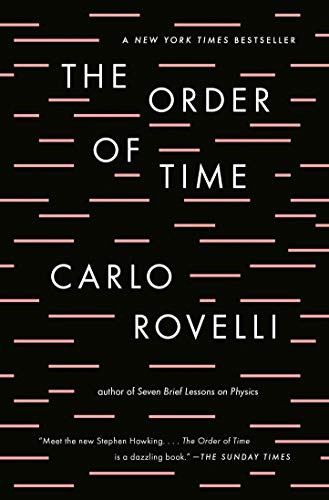
Talk to The Order of Time like its author wrote you back.
Get the ideas that fit your life — not generic summaries.
- Chat with the book
- Audiobook-style main ideas
- Adapts to your life and goals
- Helps you take action
What it argues
Carlo Rovelli's meditation on time begins with a simple observation: the time we experience — flowing forward, carrying us from past toward future — is not quite what physics describes. The Order of Time is Rovelli's attempt to reconcile what physicists know about time with what human experience tells us, and the book is organized as a systematic dismantling of familiar assumptions followed by a reconstruction of what time might actually be.
The first section takes apart the common sense view. Time does not flow at the same rate everywhere; general relativity shows that clocks run faster in weaker gravitational fields and slower near massive objects. There is no universal "now" that all observers share; simultaneity is relative. At the fundamental level of quantum gravity, Rovelli argues, time may not even appear as a basic variable in the equations — the universe's basic laws might be timeless, and time as we experience it might be emergent, like temperature in a gas.
What it gets right
- 1.
Time does not flow at the same rate everywhere. Clocks run faster at high altitude than at sea level, an effect confirmed by experiment and used in GPS calibration.
- 2.
There is no universal 'now.' Simultaneity is relative to the observer's motion and position, a consequence of special relativity.
- 3.
At the level of quantum gravity, time may not be a fundamental variable in the equations. The 'problem of time' in quantum gravity is that the basic equations are timeless.
What it covers
Who wrote it
Carlo Rovelli is an Italian theoretical physicist and professor at Aix-Marseille University, best known for his work on loop quantum gravity. He is the author of Seven Brief Lessons on Physics and Reality Is Not What It Seems, both international bestsellers. Rovelli's books are unusual in the physics genre for their literary quality: he draws on classical philosophy, poetry, and personal reflection alongside rigorous science. He is widely regarded as one of the most gifted communicators working at the intersection of fundamental physics and humanistic thought.
