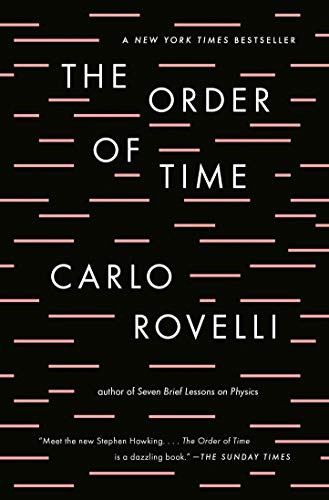
The Order of Time by Carlo Rovelli is a 2017 science book about time, physics, thermodynamics. Time does not flow at the same rate everywhere. Clocks run faster at high altitude than at sea level, an effect confirmed by experiment and used in GPS calibration.
Summary
Carlo Rovelli's meditation on time begins with a simple observation: the time we experience — flowing forward, carrying us from past toward future — is not quite what physics describes. The Order of Time is Rovelli's attempt to reconcile what physicists know about time with what human experience tells us, and the book is organized as a systematic dismantling of familiar assumptions followed by a reconstruction of what time might actually be.
The first section takes apart the common sense view. Time does not flow at the same rate everywhere; general relativity shows that clocks run faster in weaker gravitational fields and slower near massive objects. There is no universal "now" that all observers share; simultaneity is relative. At the fundamental level of quantum gravity, Rovelli argues, time may not even appear as a basic variable in the equations — the universe's basic laws might be timeless, and time as we experience it might be emergent, like temperature in a gas.
The second section addresses the arrow of time. The laws of physics at the fundamental level are time-symmetric — they work equally well forward and backward. The direction of time, from past to future, comes from thermodynamics: from the fact that entropy increases, that the universe started in a low-entropy state, and that we are creatures who retain memories of the past but not the future. Heat, disorder, and memory are, in Rovelli's account, the roots of time's directionality.
The final section is the most personal and philosophical. Rovelli draws on Anaximander, Aristotle, Heidegger, and Buddhist thought to reflect on what time means for creatures like us — beings who exist briefly, who age and die, and who experience the present as something precious precisely because it is always passing. The book is short, elegant, and at times genuinely moving. It doesn't resolve the physics of time; it explains why the question is hard and what the current best understanding suggests.
Talk to The Order of Time like its author wrote you back.
Get the ideas that fit your life — not generic summaries.
- Chat with the book
- Audiobook-style main ideas
- Adapts to your life and goals
- Helps you take action
Key takeaways
- 1.
Time does not flow at the same rate everywhere. Clocks run faster at high altitude than at sea level, an effect confirmed by experiment and used in GPS calibration.
- 2.
There is no universal 'now.' Simultaneity is relative to the observer's motion and position, a consequence of special relativity.
- 3.
At the level of quantum gravity, time may not be a fundamental variable in the equations. The 'problem of time' in quantum gravity is that the basic equations are timeless.
- 4.
The arrow of time — the fact that time flows from past to future — is not a fundamental law but a thermodynamic consequence. It comes from entropy increase and the universe's low-entropy initial conditions.
- 5.
Heat and memory are thermodynamic. We remember the past because low-entropy traces of it survive. We don't remember the future because it hasn't generated such traces yet.
- 6.
The present moment is not a universal feature of reality. What we call 'now' is a local, approximate concept that breaks down at large distances and high relative velocities.
- 7.
The experience of time — its passage, its texture, its emotional weight — is likely a product of our biology and thermodynamics, not a direct readout of physical time.
Discussion questions
Use these on your own, with a book club, or as chat starters in Superbook. Book club version, ready to copy or print →
- 1.
Rovelli argues that the present is local rather than universal. Does that idea change how you think about the phrase 'right now' when referring to distant events?
- 2.
If the fundamental laws of physics are time-symmetric, why does time feel so strongly directional? Did Rovelli's thermodynamic explanation satisfy you?
- 3.
Rovelli suggests that time as we experience it may be emergent — a large-scale property arising from timeless fundamental physics. Is that a meaningful distinction or a semantic one?
- 4.
The book draws on physics, philosophy, and poetry in roughly equal measure. Did those registers work together for you or feel mismatched?
- 5.
Rovelli ends with a reflection on mortality and the preciousness of the present. Did the physics of time make that reflection feel more or less earned?
- 6.
Memory depends on low-entropy traces of the past. If entropy is the root of memory, what does that say about how we construct identity?
- 7.
The 'problem of time' in quantum gravity has no agreed solution. Does knowing that physicists haven't resolved this change how confident you are in other physics you've accepted?
- 8.
Rovelli quotes Anaximander, Aristotle, and Buddhist thinkers on time. Did those sources enrich the argument or feel like padding?
- 9.
General relativity implies that time runs faster on a mountain than in a valley. Does that change how you think about living at altitude?
- 10.
Rovelli argues that the present moment exists only locally and that 'now' loses meaning over large distances. Is that disturbing, liberating, or just strange?
- 11.
The book is as much a work of literary nonfiction as popular science. Does that hybrid form serve the subject of time better than a straightforwardly scientific approach would?
- 12.
After reading this book, do you feel you understand time better, or just understand better how much is not understood?
Themes
Frequently asked questions
-
Is The Order of Time a physics book or a philosophy book?
Both, genuinely. The first half is physics — general relativity, thermodynamics, quantum gravity. The second half is more philosophical and personal, drawing on Greek philosophy, Buddhist thought, and reflection on mortality. Rovelli integrates these without pretending they are the same thing.
-
How long does it take to read?
About two to three hours. It is a short book, beautifully produced in translation. The density varies: the opening sections on relativistic time require concentration; the later reflections on memory and mortality read more like essays.
-
What is the main argument of The Order of Time?
That time as we commonly understand it — universal, flowing uniformly forward — is not what physics describes. Time is relative, slows near mass, may not exist at the most fundamental level, and has a direction only because of thermodynamics. The present is local and the 'now' we experience is a product of our biology and memory.
-
Do I need to read Seven Brief Lessons on Physics first?
No. The Order of Time stands alone and includes necessary background on general relativity and thermodynamics. Readers who enjoyed Seven Brief Lessons will find this deeper and more focused, but it is not a sequel.
-
Is the book scientifically accurate?
The physics is accurate and drawn from Rovelli's own research area. Some of the claims about quantum gravity are more speculative — particularly the claim that time disappears at the Planck scale — and represent Rovelli's interpretation of a field where no consensus exists. He is generally clear about the difference between established physics and open questions.
Similar books
Seven Brief Lessons on Physics
Carlo Rovelli
Reality Is Not What It Seems
Carlo Rovelli
Four Laws That Drive the Universe
Peter Atkins
Astrophysics for People in a Hurry
Neil deGrasse Tyson
