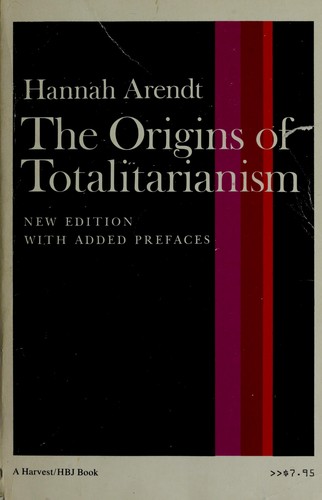
Talk to The Origins of Totalitarianism like its author wrote you back.
Get the ideas that fit your life — not generic summaries.
- Chat with the book
- Audiobook-style main ideas
- Adapts to your life and goals
- Helps you take action
What it argues
Hannah Arendt published The Origins of Totalitarianism in 1951, just six years after the end of World War II. Writing in the immediate shadow of the Nazi and Stalinist regimes, she attempted something that most of her contemporaries thought was impossible: a rigorous analytical account of how totalitarianism emerged from within European civilization, not as an alien intrusion but as a product of its own contradictions and pathologies.
The book is organized in three parts. The first traces the history of European antisemitism, arguing that it was not simply a constant feature of Western culture but a specifically modern ideological construct that arose as the role of Jews in European finance and statecraft changed. The second examines nineteenth-century imperialism, showing how the techniques of racial domination developed in colonial Africa and Asia were eventually imported back into Europe. The third part analyzes totalitarianism itself — its organizational structure, its use of terror, its ideological logic, and the nature of the concentration camps.
What it gets right
- 1.
Totalitarianism was a genuinely new form of government, distinct from tyranny or despotism. Its goal was not simply power but the transformation of human nature and the elimination of spontaneous thought and action.
- 2.
Modern antisemitism was not a continuous tradition but a historically specific ideology that arose when Jews lost their older political and economic functions while retaining their social distinctiveness.
- 3.
The techniques of racial domination developed during European imperialism — in Africa and Asia — provided a template and a precedent for the racial terror of Nazism inside Europe.
What it covers
Who wrote it
Hannah Arendt (1906–1975) was a German-American political philosopher and one of the most important political thinkers of the twentieth century. She fled Nazi Germany in 1933, was briefly interned in a French camp, and eventually settled in the United States. Her other major works include The Human Condition, Eichmann in Jerusalem, and On Revolution. She taught at the New School for Social Research and the University of Chicago. Her concepts of "banality of evil" and totalitarianism remain central to political philosophy and historical analysis.
