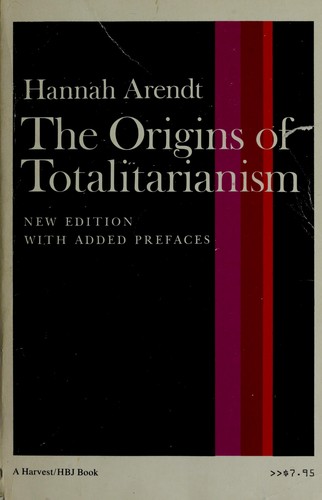
The Origins of Totalitarianism by Hannah Arendt is a 1951 history book about totalitarianism, political philosophy, antisemitism. Totalitarianism was a genuinely new form of government, distinct from tyranny or despotism. Its goal was not simply power but the transformation of human nature and the elimination of spontaneous thought and action.
Summary
Hannah Arendt published The Origins of Totalitarianism in 1951, just six years after the end of World War II. Writing in the immediate shadow of the Nazi and Stalinist regimes, she attempted something that most of her contemporaries thought was impossible: a rigorous analytical account of how totalitarianism emerged from within European civilization, not as an alien intrusion but as a product of its own contradictions and pathologies.
The book is organized in three parts. The first traces the history of European antisemitism, arguing that it was not simply a constant feature of Western culture but a specifically modern ideological construct that arose as the role of Jews in European finance and statecraft changed. The second examines nineteenth-century imperialism, showing how the techniques of racial domination developed in colonial Africa and Asia were eventually imported back into Europe. The third part analyzes totalitarianism itself — its organizational structure, its use of terror, its ideological logic, and the nature of the concentration camps.
Arendt's central argument is that totalitarianism was genuinely novel. It was not simply a more brutal version of tyranny or despotism. What made it different was its goal: not merely to dominate people but to transform human nature itself, to eliminate the capacity for individual thought and political action. The camps were not incidental to this project — they were its laboratory. Arendt coined the phrase "banality of evil" a decade later, but its roots are here: in her analysis of how ordinary bureaucratic functioning made mass atrocity possible.
The book is difficult — dense, philosophical, and sometimes digressive. Arendt was working at the edge of what could be understood using existing conceptual frameworks. She was trying to invent the vocabulary for something genuinely new. That makes it demanding but also irreplaceable. Nearly every serious analysis of authoritarianism, populism, or democratic backsliding in the decades since has had to reckon with her argument.
Talk to The Origins of Totalitarianism like its author wrote you back.
Get the ideas that fit your life — not generic summaries.
- Chat with the book
- Audiobook-style main ideas
- Adapts to your life and goals
- Helps you take action
Key takeaways
- 1.
Totalitarianism was a genuinely new form of government, distinct from tyranny or despotism. Its goal was not simply power but the transformation of human nature and the elimination of spontaneous thought and action.
- 2.
Modern antisemitism was not a continuous tradition but a historically specific ideology that arose when Jews lost their older political and economic functions while retaining their social distinctiveness.
- 3.
The techniques of racial domination developed during European imperialism — in Africa and Asia — provided a template and a precedent for the racial terror of Nazism inside Europe.
- 4.
Terror is the essence of totalitarian government. It serves not to punish opponents but to destroy the capacity for opposition before it can form, making the population act as if they were guilty regardless of their actual behavior.
- 5.
The concentration camp was the totalitarian institution par excellence — not a prison but an experiment in eliminating the conditions that make human beings human: spontaneity, plurality, individuality.
- 6.
Ideology in totalitarian systems is not a set of beliefs but a logic-machine that, once accepted, generates conclusions with perfect consistency regardless of reality.
- 7.
The collapse of traditional institutions — family, church, class — left mass populations atomized and susceptible to totalitarian mobilization. Loneliness and rootlessness were preconditions, not just symptoms.
- 8.
The stateless and the refugee were not anomalies of the twentieth century but early indicators of the crisis of the nation-state system and human rights doctrine's dependence on citizenship.
Discussion questions
Use these on your own, with a book club, or as chat starters in Superbook. Book club version, ready to copy or print →
- 1.
Arendt argues totalitarianism was genuinely unprecedented. What does that claim require us to give up in terms of historical analogy and comparison?
- 2.
She traces the origins of Nazi ideology partly through the history of European imperialism. Does that connection hold up, and what does it imply about European self-understanding?
- 3.
Arendt describes the atomization and loneliness of mass society as preconditions for totalitarianism. Where do you see comparable conditions today?
- 4.
What is the difference between Arendt's concept of totalitarianism and ordinary authoritarianism or dictatorship? Does that distinction still matter in contemporary political analysis?
- 5.
Her analysis of propaganda suggests that the goal is not to deceive people about facts but to destroy their capacity to trust facts at all. What examples does that idea bring to mind?
- 6.
Arendt argues human rights are meaningful only when backed by political membership and citizenship. What does that imply for how we think about stateless people and refugees today?
- 7.
How does the book's three-part structure — antisemitism, imperialism, totalitarianism — shape its argument? Could those elements be understood independently, or does the sequence matter?
- 8.
Arendt's prose is notoriously dense and philosophical. What does that kind of writing demand of its readers, and is the difficulty justified by what you gain from it?
- 9.
The book was written in 1951. Which parts feel most dated, and which feel most prescient given the last twenty years of political history?
- 10.
Arendt later wrote about the 'banality of evil' in Eichmann in Jerusalem. How does her argument in Origins prefigure that idea?
- 11.
What does Arendt think makes people susceptible to totalitarian ideology? Is her explanation primarily structural, psychological, or ideological?
- 12.
The book ends without a clear prescription for preventing totalitarianism. Is that absence a weakness or a form of intellectual honesty?
Themes
Frequently asked questions
-
Is The Origins of Totalitarianism still relevant?
Yes. Its analysis of how democratic institutions erode, how ideological thinking displaces factual reasoning, and how atomized populations become susceptible to authoritarian mobilization has been cited repeatedly in analyses of contemporary political trends in Europe, the US, and elsewhere.
-
How difficult is The Origins of Totalitarianism to read?
It is demanding. Arendt writes with philosophical precision and assumes familiarity with European history. The third section, on totalitarianism itself, is more accessible than the first two. Many readers find it worthwhile to read secondary introductions alongside the text.
-
What is the main argument of The Origins of Totalitarianism?
That totalitarianism was a genuinely new form of political domination that emerged from specific European historical conditions — antisemitism, imperialism, and the collapse of the nation-state system — and that its defining feature was the attempt to eliminate human spontaneity and plurality rather than simply to seize power.
-
Who should read The Origins of Totalitarianism?
Readers seriously interested in twentieth-century political history, political philosophy, or the conditions that produce authoritarian politics. It rewards patience and is most useful for people willing to engage with its conceptual framework rather than treat it as a history book.
-
What does Arendt mean by totalitarianism being new?
She means it differed from classical tyranny in its goal: not simply ruling a population but transforming human nature by eliminating the capacity for independent thought and political action. The terror it wielded served not to punish specific enemies but to destroy the conditions for resistance before they could form.