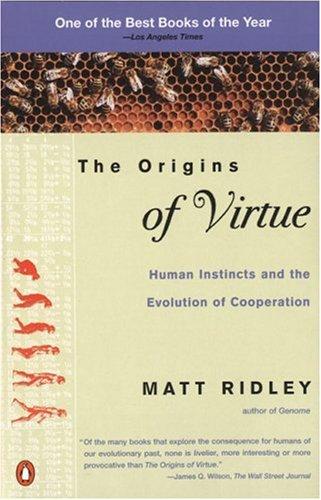
Talk to The Origins of Virtue: Human Instincts and the Evolution of Cooperation like its author wrote you back.
Get the ideas that fit your life — not generic summaries.
- Chat with the book
- Audiobook-style main ideas
- Adapts to your life and goals
- Helps you take action
What it argues
The Origins of Virtue begins from a puzzle: humans cooperate extensively with non-relatives, a behavior that seems to contradict the logic of natural selection, which predicts that organisms should act in the interests of their genes and close kin. Matt Ridley's argument is that cooperation is not a contradiction of evolution but a product of it — shaped by specific mechanisms, including kin selection, reciprocal altruism, and the game theory of repeated interactions, that made cooperation the winning strategy in particular social environments.
Ridley moves through evolutionary biology, game theory, and anthropology to build the case. He covers the Prisoner's Dilemma and Robert Axelrod's computer tournaments showing that tit-for-tat strategies outperform defection in iterated games. He examines hunter-gatherer societies to show that the division of labor, sharing, and collective action appear across cultures as human universals, suggesting deep evolutionary roots. He covers kin selection — the Hamilton rule that individuals will sacrifice for relatives proportional to their genetic relatedness — and reciprocal altruism, Trivers's theory that cooperation with non-relatives can evolve when the partners interact repeatedly and have good memories.
What it gets right
- 1.
Human cooperation at scale is an evolutionary puzzle: natural selection favors genes, yet humans cooperate extensively with non-relatives. The book argues specific mechanisms solve this puzzle.
- 2.
Kin selection explains cooperation between relatives: organisms behave altruistically toward kin in proportion to their genetic relatedness, as Hamilton's rule predicts.
- 3.
Reciprocal altruism allows cooperation among non-relatives when interactions are repeated, partners have memories, and defection is punished. Tit-for-tat is a robust strategy in these conditions.
What it covers
Who wrote it
Matt Ridley is a British science writer and member of the House of Lords. He was born in 1958 and studied zoology at Oxford before writing science for The Economist and then as a full-time author. His books include The Red Queen, Genome, Nature Via Nurture, The Rational Optimist, and The Evolution of Everything. The Origins of Virtue was his third major book and applies evolutionary biology to questions of ethics and political economy. He is known for arguing against pessimism about human nature and institutions, drawing on a mix of evolutionary theory and classical liberal economics.
