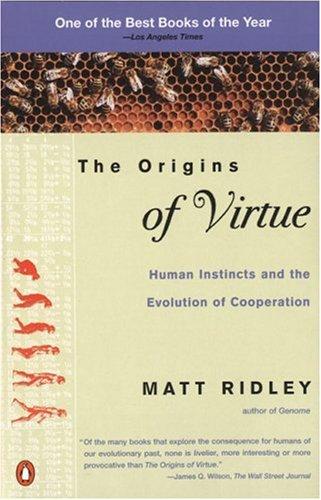
The Origins of Virtue: Human Instincts and the Evolution of Cooperation by Matt Ridley is a 1996 science book about cooperation, evolution, human nature. Human cooperation at scale is an evolutionary puzzle: natural selection favors genes, yet humans cooperate extensively with non-relatives. The book argues specific mechanisms solve this puzzle.
Summary
The Origins of Virtue begins from a puzzle: humans cooperate extensively with non-relatives, a behavior that seems to contradict the logic of natural selection, which predicts that organisms should act in the interests of their genes and close kin. Matt Ridley's argument is that cooperation is not a contradiction of evolution but a product of it — shaped by specific mechanisms, including kin selection, reciprocal altruism, and the game theory of repeated interactions, that made cooperation the winning strategy in particular social environments.
Ridley moves through evolutionary biology, game theory, and anthropology to build the case. He covers the Prisoner's Dilemma and Robert Axelrod's computer tournaments showing that tit-for-tat strategies outperform defection in iterated games. He examines hunter-gatherer societies to show that the division of labor, sharing, and collective action appear across cultures as human universals, suggesting deep evolutionary roots. He covers kin selection — the Hamilton rule that individuals will sacrifice for relatives proportional to their genetic relatedness — and reciprocal altruism, Trivers's theory that cooperation with non-relatives can evolve when the partners interact repeatedly and have good memories.
The more provocative strand of the book examines what institutions actually enable human cooperation at scale. Ridley contrasts cases where communities manage shared resources sustainably without central authority — Elinor Ostrom's work on the commons — with cases where government intervention or top-down management disrupts the informal norms that made cooperation work. He draws a conclusion that not everyone will share: that human social instincts toward reciprocity and reputation-based trust are robust enough to sustain cooperation in many domains without state enforcement, and that excessive intervention can crowd out these instincts.
The final section addresses what this evolutionary account implies for ethics. Ridley argues that moral intuitions — fairness, reciprocity, disgust at cheating — are not arbitrary cultural constructs but evolved mechanisms that track conditions favorable to cooperation. This does not make them immune to criticism or fixed in form, but it does give them an explanation that is neither pure rationalism nor pure cultural relativism. The book is persuasive on the evolutionary mechanisms and more contested on the political implications.
Talk to The Origins of Virtue: Human Instincts and the Evolution of Cooperation like its author wrote you back.
Get the ideas that fit your life — not generic summaries.
- Chat with the book
- Audiobook-style main ideas
- Adapts to your life and goals
- Helps you take action
Key takeaways
- 1.
Human cooperation at scale is an evolutionary puzzle: natural selection favors genes, yet humans cooperate extensively with non-relatives. The book argues specific mechanisms solve this puzzle.
- 2.
Kin selection explains cooperation between relatives: organisms behave altruistically toward kin in proportion to their genetic relatedness, as Hamilton's rule predicts.
- 3.
Reciprocal altruism allows cooperation among non-relatives when interactions are repeated, partners have memories, and defection is punished. Tit-for-tat is a robust strategy in these conditions.
- 4.
The Prisoner's Dilemma and Axelrod's tournaments show that cooperative strategies outperform selfish ones in repeated games, explaining why social animals evolve mutual aid.
- 5.
Hunter-gatherer societies show division of labor, sharing, and collective management of resources as near-universal features, suggesting these patterns have deep evolutionary roots.
- 6.
Ostrom's work on the commons shows that communities can sustainably manage shared resources through informal norms and reputation without state authority, when the conditions are right.
- 7.
Moral intuitions around fairness, reciprocity, and disgust at cheating are evolutionary adaptations that track conditions favoring cooperation, not arbitrary cultural impositions.
- 8.
Institutions that crowd out informal reciprocity and reputation-based trust — by replacing community management with state enforcement — can degrade cooperation rather than support it.
Discussion questions
Use these on your own, with a book club, or as chat starters in Superbook. Book club version, ready to copy or print →
- 1.
Ridley argues that cooperation is a product of evolution rather than a contradiction of it. Does this explanation change how you think about human goodness or morality?
- 2.
The tit-for-tat strategy works in iterated games with memory. Where in your own professional or social life do you see people applying something like tit-for-tat, whether deliberately or not?
- 3.
Ridley draws on Ostrom's commons research to argue that community-managed resources often work better than state-managed ones. What conditions seem necessary for this to hold?
- 4.
The book suggests that moral intuitions like fairness and reciprocity are evolutionary adaptations. Does an evolutionary origin make these intuitions more or less authoritative as moral guides?
- 5.
Kin selection predicts that people will cooperate more readily with genetic relatives. Where does this actually show up in your life, and where does it break down?
- 6.
Ridley is skeptical about centralized management of resources and cooperation. How do you evaluate this argument? Where do you think his skepticism is warranted and where does it go too far?
- 7.
The book uses game theory to explain cooperation. What are the limits of applying mathematical models of strategy to actual human social behavior?
- 8.
Hunter-gatherer division of labor is presented as a human universal. What does this imply about the naturalness of economic exchange and specialization?
- 9.
Ridley argues that too much government intervention crowds out voluntary cooperation. Is there evidence in your own experience that this tradeoff exists?
- 10.
Cooperation requires reputation — others need to know your history of keeping or breaking agreements. How does digital technology change the conditions under which reputation can operate?
- 11.
The book ends with a cautious optimism about human nature. Do you find this optimism persuasive given the evidence it rests on?
Themes
Frequently asked questions
-
What is The Origins of Virtue about?
It is an account of how human cooperation and moral instincts evolved. Ridley uses evolutionary biology, game theory, and anthropology to argue that behaviors like fairness, reciprocity, and collective action are not cultural inventions but adaptations shaped by natural selection across millions of years of social living.
-
Is this book relevant to economics or political philosophy?
Yes. Ridley uses the evolutionary account to argue that communities can often manage shared resources and cooperative arrangements without central authority, drawing on Elinor Ostrom's research. Readers interested in political economy, public goods, and the relationship between markets and community will find substantial material here.
-
Does the book take a political position?
Implicitly, yes. Ridley is skeptical of state-managed solutions to collective problems and sympathetic to decentralized, community-based arrangements. He argues from evolutionary science rather than ideology, but the policy implications he draws are generally in a classical liberal direction, which some readers find persuasive and others find selective.
-
How does this book relate to The Red Queen?
Both books apply evolutionary logic to human behavior. The Red Queen focuses on sex and mate selection; The Origins of Virtue focuses on cooperation and morality. They share a style and framework and are often read together, though each is self-contained.
-
Who should read The Origins of Virtue?
Readers interested in evolutionary biology, moral philosophy, and the science of cooperation. It is also relevant for anyone thinking about how institutions and informal norms interact. The game theory sections assume no prior background. Readers who found The Red Queen or The Selfish Gene rewarding will likely enjoy this one.
Similar books
The Red Queen: Sex and the Evolution of Human Nature
Matt Ridley
The Selfish Gene
Richard Dawkins
The Righteous Mind: Why Good People Are Divided by Politics and Religion
Jonathan Haidt
Sapiens: A Brief History of Humankind
Yuval Noah Harari
