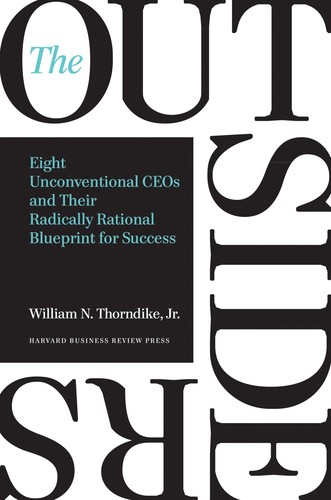
Talk to The Outsiders: Eight Unconventional CEOs and Their Radically Rational Blueprint for Success like its author wrote you back.
Get the ideas that fit your life — not generic summaries.
- Chat with the book
- Audiobook-style main ideas
- Adapts to your life and goals
- Helps you take action
What it argues
The Outsiders profiles eight CEOs whose long-term returns to shareholders dramatically outperformed the S&P 500 and their industry peers, often by factors of ten to one hundred. What connects them is not industry, management style, or personality, but a shared approach to capital allocation that Thorndike argues was both unusual and decisive. They include Tom Murphy of Capital Cities/ABC, Henry Singleton of Teledyne, Katharine Graham of The Washington Post, John Malone of TCI, and Warren Buffett of Berkshire Hathaway — alongside three lesser-known figures who produced comparably extraordinary results.
Thorndike's central claim is that the CEOs most celebrated by business media — the charismatic visionaries, the aggressive acquirers, the empire builders — are not usually the ones who create the most shareholder value. The Outsiders avoided the spotlight, shunned unnecessary acquisitions, were indifferent to quarterly earnings management, and thought obsessively about the highest-value use of every dollar the business generated. Their capital allocation decisions — when to buy back stock, when to acquire, when to issue equity, and when to simply hold cash — were treated as the primary CEO function, not a secondary duty delegated to the CFO.
What it gets right
- 1.
Capital allocation — deciding where to deploy the cash a business generates — is the primary function of a CEO, and most CEOs are mediocre at it.
- 2.
The Outsiders all favored share buybacks when their stock was cheap over acquisitions, dividends, or holding cash, because they understood that buying undervalued stock is the highest-return use of capital.
- 3.
Decentralization was a common operating philosophy: hire excellent managers, give them real authority, hold them accountable for results, and stay out of their way.
What it covers
Who wrote it
William N. Thorndike Jr. is an American private equity investor and founder of Housatonic Partners, a Boston-based investment firm. He has served on numerous corporate boards and has spent his career studying long-term business performance and capital allocation. The Outsiders, published in 2012, was praised by Warren Buffett as "the best business book I've read in years." Thorndike teaches a case study course based on the book's profiles. It remains his only major published work, though he writes occasionally on investment topics.
