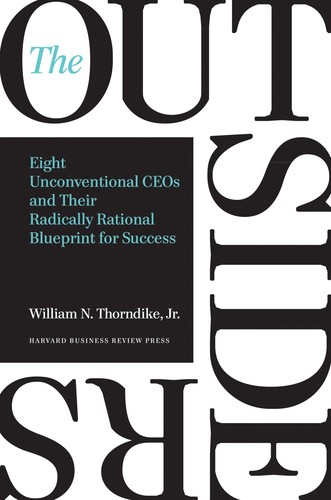
The Outsiders: Eight Unconventional CEOs and Their Radically Rational Blueprint for Success by William N. Thorndike is a 2012 business book about capital allocation, ceo leadership, investing. Capital allocation — deciding where to deploy the cash a business generates — is the primary function of a CEO, and most CEOs are mediocre at it.
Summary
The Outsiders profiles eight CEOs whose long-term returns to shareholders dramatically outperformed the S&P 500 and their industry peers, often by factors of ten to one hundred. What connects them is not industry, management style, or personality, but a shared approach to capital allocation that Thorndike argues was both unusual and decisive. They include Tom Murphy of Capital Cities/ABC, Henry Singleton of Teledyne, Katharine Graham of The Washington Post, John Malone of TCI, and Warren Buffett of Berkshire Hathaway — alongside three lesser-known figures who produced comparably extraordinary results.
Thorndike's central claim is that the CEOs most celebrated by business media — the charismatic visionaries, the aggressive acquirers, the empire builders — are not usually the ones who create the most shareholder value. The Outsiders avoided the spotlight, shunned unnecessary acquisitions, were indifferent to quarterly earnings management, and thought obsessively about the highest-value use of every dollar the business generated. Their capital allocation decisions — when to buy back stock, when to acquire, when to issue equity, and when to simply hold cash — were treated as the primary CEO function, not a secondary duty delegated to the CFO.
Each chapter is a case study examining how a specific CEO allocated capital over a long tenure, what circumstances they faced, and how their decisions compared to industry peers. Thorndike writes with analytical clarity and avoids hagiography; the profiles include the constraints each CEO worked under, not just the decisions that worked. The chapter on Katharine Graham is notable for showing how an initially reluctant CEO became one of the most rigorous capital allocators in media history under pressure.
The book's weakness is selection bias. These are cases where the unconventional approach worked; there is no parallel analysis of CEOs who applied similar frameworks and produced average or poor returns. Thorndike addresses this briefly but the sample is clearly cherry-picked. Still, as an account of what disciplined capital allocation looks like in practice — and as a corrective to the conventional business press obsession with growth and expansion — The Outsiders is unusually clear-eyed and specific.
Talk to The Outsiders: Eight Unconventional CEOs and Their Radically Rational Blueprint for Success like its author wrote you back.
Get the ideas that fit your life — not generic summaries.
- Chat with the book
- Audiobook-style main ideas
- Adapts to your life and goals
- Helps you take action
Key takeaways
- 1.
Capital allocation — deciding where to deploy the cash a business generates — is the primary function of a CEO, and most CEOs are mediocre at it.
- 2.
The Outsiders all favored share buybacks when their stock was cheap over acquisitions, dividends, or holding cash, because they understood that buying undervalued stock is the highest-return use of capital.
- 3.
Decentralization was a common operating philosophy: hire excellent managers, give them real authority, hold them accountable for results, and stay out of their way.
- 4.
These CEOs were largely indifferent to media attention, quarterly earnings management, and the conventional wisdom of their industries, which freed them to take longer-horizon decisions.
- 5.
Acquisition discipline matters as much as acquisition activity: the Outsiders bought businesses at rational prices for strategic reasons and avoided the empire-building instinct that destroys value in most M&A.
- 6.
Per-share value, not total enterprise scale, is the right measure of management performance. Growing the business while diluting shareholders is not success.
- 7.
Long tenure matters: each of the Outsiders held their position for many years, long enough for compounding to work and for early decisions to be vindicated by time.
- 8.
The investment frameworks that work for long-term investors also work for CEOs: patient, rational allocation of capital with a clear view of intrinsic value.
Discussion questions
Use these on your own, with a book club, or as chat starters in Superbook. Book club version, ready to copy or print →
- 1.
Thorndike argues capital allocation is the CEO's most important function. How does the capital allocation process actually work in your organization, and who owns it?
- 2.
The Outsiders avoided acquisitions that didn't meet strict return hurdles. What acquisition decisions in your industry have you seen destroy value, and what drove them?
- 3.
Each profile shows a CEO who was willing to be deeply contrarian with respect to their industry's conventional wisdom. What would it take for you to make a similar bet against consensus in your field?
- 4.
Share buybacks were the preferred capital return mechanism for most of the Outsiders. How does your organization's leadership think about the tradeoff between returning capital to shareholders and reinvesting it in the business?
- 5.
Thorndike emphasizes long tenure as a prerequisite for many of these strategies to work. What happens to long-horizon decision-making in organizations where CEO tenure is short?
- 6.
The Outsiders were mostly indifferent to quarterly earnings guidance and media coverage. What organizational and market forces make that indifference nearly impossible in public companies today?
- 7.
Decentralized management was a shared operating principle. What does genuine decentralization require from executives at the center, and where does it typically fail?
- 8.
Thorndike acknowledges selection bias in his sample. How much does that limit the book's prescriptive value? Can you think of cases where the same logic led to worse outcomes?
- 9.
Katharine Graham is the only CEO in the book who led a media company and who inherited the role. What about her story surprised you or challenged an assumption you brought to it?
- 10.
Per-share value versus total enterprise growth: where in your organization's metrics and incentives is this distinction made clearly, and where is it muddied?
- 11.
Warren Buffett is the most famous Outsider. Did reading his profile alongside less-known figures like Henry Singleton change how you understand Buffett's approach?
- 12.
What business or leader in your industry today comes closest to the Outsider archetype? What is keeping them from greater recognition?
Themes
Frequently asked questions
-
Is The Outsiders worth reading for non-investors?
Yes. The capital allocation framework is applicable to any organization that generates cash, not just public companies. The management principles — decentralization, long-horizon thinking, indifference to consensus — are relevant to any executive making resource allocation decisions.
-
What is The Outsiders book about?
It profiles eight CEOs who dramatically outperformed their peers by treating capital allocation as their primary function. Thorndike argues they succeeded not through charisma or bold strategy but through rational, disciplined decisions about how to deploy the cash their businesses generated.
-
How long does it take to read The Outsiders?
About five hours. The case studies are tight and analytical without being dense. Most readers find it moves quickly because each chapter follows a similar structure, making the comparisons across profiles easy to track.
-
Who should read The Outsiders?
Investors, executives, and board members thinking seriously about how management creates or destroys shareholder value. Also useful for business school students and anyone studying long-term corporate performance.
-
What is the most important idea in The Outsiders?
That per-share value, not enterprise scale, is the right measure of CEO performance. Most executives optimize for growing the business in absolute terms; the Outsiders optimized for maximizing what each share was worth, which required a fundamentally different set of decisions.