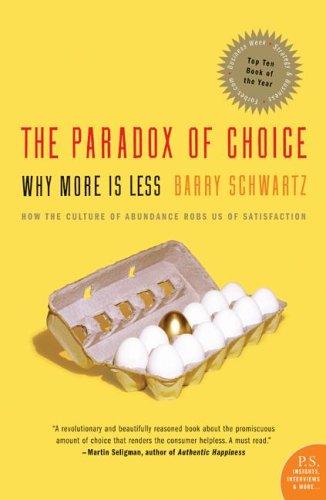
Talk to The Paradox of Choice: Why More Is Less like its author wrote you back.
Get the ideas that fit your life — not generic summaries.
- Chat with the book
- Audiobook-style main ideas
- Adapts to your life and goals
- Helps you take action
What it argues
Barry Schwartz argues that the expansion of consumer choice in wealthy societies has not produced the freedom and happiness it promised. Beyond a certain threshold, more options make decisions harder, increase anticipated regret, and reduce satisfaction with outcomes that would have seemed excellent if fewer alternatives had existed. The Paradox of Choice, published in 2004, is his account of the psychology behind this effect and a prescription for how to manage it.
The book distinguishes maximizers from satisficers. A maximizer must find the objectively best option; a satisficer searches until they find something good enough. Maximizers spend more time deciding, feel worse about their choices afterward, and report lower well-being than satisficers even when they end up with objectively better outcomes. The standard case for choice assumes people want to maximize; Schwartz argues this assumption is both psychologically false and practically harmful.
What it gets right
- 1.
Beyond a threshold, more choice produces decision paralysis, greater anticipated regret, and lower satisfaction — not more freedom or well-being.
- 2.
Maximizers, who search for the best option, consistently make better objective choices and feel worse about them than satisficers, who stop at good enough.
- 3.
Opportunity cost accumulates with every added option. The more alternatives exist, the more vivid the paths not taken, and the more each detracts from satisfaction with the choice made.
What it covers
Who wrote it
Barry Schwartz is professor emeritus of psychology at Swarthmore College, where he taught for more than forty years. He has also been a visiting professor at the Haas School of Business at Berkeley. His work focuses on the intersection of psychology, economics, and moral philosophy. His TED talk on the paradox of choice is one of the most watched in TED's history. He has also written Practical Wisdom and Why We Work, which extend his critique of markets and incentives into professional and educational domains.
