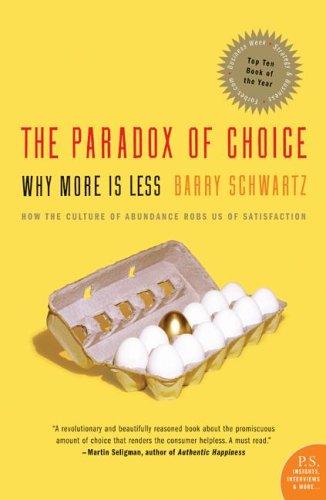
The Paradox of Choice: Why More Is Less by Barry Schwartz is a 2004 psychology book about decision-making, choice, happiness. Beyond a threshold, more choice produces decision paralysis, greater anticipated regret, and lower satisfaction — not more freedom or well-being.
Summary
Barry Schwartz argues that the expansion of consumer choice in wealthy societies has not produced the freedom and happiness it promised. Beyond a certain threshold, more options make decisions harder, increase anticipated regret, and reduce satisfaction with outcomes that would have seemed excellent if fewer alternatives had existed. The Paradox of Choice, published in 2004, is his account of the psychology behind this effect and a prescription for how to manage it.
The book distinguishes maximizers from satisficers. A maximizer must find the objectively best option; a satisficer searches until they find something good enough. Maximizers spend more time deciding, feel worse about their choices afterward, and report lower well-being than satisficers even when they end up with objectively better outcomes. The standard case for choice assumes people want to maximize; Schwartz argues this assumption is both psychologically false and practically harmful.
Several mechanisms explain why more choice produces worse outcomes. Opportunity cost is one: with many options, the paths not taken remain vivid, and each forgone alternative becomes a deduction from satisfaction with the chosen one. Adaptation is another: we adapt to positive outcomes faster than we expect, but only if we stop comparing them to alternatives. Regret anticipation is a third: knowing there are many options increases the chance of regret, so people either avoid deciding or feel worse afterward.
Schwartz recommends a set of practical strategies: satisfice rather than maximize, practice gratitude rather than comparison, limit options by making rules in advance, and treat some choices as non-decisions. The prescription is deliberately against the prevailing consumer ideology, which equates choice with freedom. Schwartz argues that radical freedom of choice can be a burden rather than a gift — that constraints, in many domains, make people happier rather than less free.
Talk to The Paradox of Choice: Why More Is Less like its author wrote you back.
Get the ideas that fit your life — not generic summaries.
- Chat with the book
- Audiobook-style main ideas
- Adapts to your life and goals
- Helps you take action
Key takeaways
- 1.
Beyond a threshold, more choice produces decision paralysis, greater anticipated regret, and lower satisfaction — not more freedom or well-being.
- 2.
Maximizers, who search for the best option, consistently make better objective choices and feel worse about them than satisficers, who stop at good enough.
- 3.
Opportunity cost accumulates with every added option. The more alternatives exist, the more vivid the paths not taken, and the more each detracts from satisfaction with the choice made.
- 4.
Adaptation to outcomes is faster than anticipated. This is partly good news — disappointments fade — but it also means anticipated pleasures often disappoint, because they were never evaluated against alternatives.
- 5.
Regret is both anticipated and retrospective. With many options, the chance of regret is higher, so people pre-suffer the possibility of error before deciding and post-suffer comparisons to alternatives after.
- 6.
Self-blame rises with choice. If you had only one option and it turned out badly, bad luck is the explanation. If you chose from twenty options, you are responsible for not choosing better.
- 7.
Practical strategies: satisfice in most domains, create rules and commitments that pre-decide choices, practice gratitude deliberately, and limit comparisons to the unchosen options.
Discussion questions
Use these on your own, with a book club, or as chat starters in Superbook. Book club version, ready to copy or print →
- 1.
Are you a maximizer or a satisficer? Can you identify domains where you satisfice and others where you maximizer, and what makes the difference?
- 2.
Schwartz argues that constraints make people happier. Can you think of a constraint in your life — a rule, a commitment, a limitation — that has actually improved your experience rather than limited it?
- 3.
The book predates social media and recommendation algorithms. How have those technologies interacted with the paradox of choice — resolved it or made it worse?
- 4.
Think of a decision you made recently that left you less satisfied than you expected. Can you trace which mechanisms Schwartz describes were operating?
- 5.
He argues that maximizing and satisficing are partly personality traits and partly learned tendencies. Is there a domain where you would like to become more of a satisficer?
- 6.
The opportunity cost argument says that unchosen alternatives detract from satisfaction with what you chose. Is there something you chose that you would enjoy more if you stopped imagining alternatives?
- 7.
Self-blame rises with choice because you could have chosen differently. How does this interact with how we evaluate outcomes in areas like career, relationship, and health?
- 8.
Schwartz recommends pre-committing to rules that remove certain decisions. What decisions in your life would benefit from being converted into rules?
- 9.
The political dimension of the book is that consumer choice has been conflated with human freedom. Do you agree with that critique? What are the limits of that equation?
- 10.
He discusses adaptation — our tendency to return to a baseline of satisfaction after both good and bad outcomes. What implications does adaptation have for how you think about major life decisions?
- 11.
Which of Schwartz's prescriptions do you find most plausible and which most difficult to apply to your actual life?
Themes
Frequently asked questions
-
Has the paradox of choice been replicated?
Partially. The original jam experiment — which found that customers bought more when shown six options than twenty-four — failed to replicate in subsequent studies, and the effect size in the original was disputed. The underlying psychological mechanisms are better supported than the specific consumer choice studies.
-
Is the book saying we should have fewer options?
Not politically. Schwartz is not arguing for restricting choice externally. He is arguing that individuals and institutions should recognize the psychological costs of choice abundance and develop strategies — satisficing, pre-commitment, limiting comparisons — to manage them.
-
What is a satisficer?
Someone who sets a threshold of what would be good enough and stops searching when that threshold is met. The term comes from Herbert Simon, who coined it as a combination of 'satisfy' and 'suffice.' Schwartz argues satisficers are consistently happier than maximizers.
-
Is this book still relevant after twenty years?
More relevant, arguably. The proliferation of streaming services, dating apps, and e-commerce has dramatically expanded consumer choice since 2004. The psychological mechanisms Schwartz describes apply at least as strongly to the current environment.
-
What is the most actionable idea in the book?
Satisfice deliberately in areas that matter most. Pick a standard of good enough, stop when you reach it, and resist the comparison of unchosen alternatives afterward. This is harder than it sounds and more valuable than almost any other decision-making intervention.