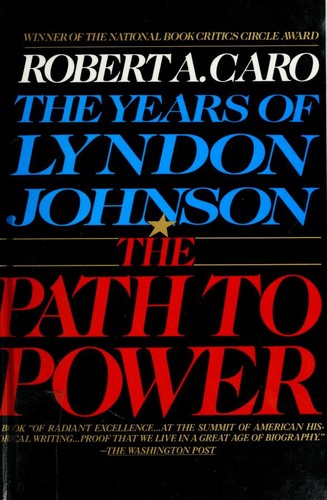
Talk to The Path to Power like its author wrote you back.
Get the ideas that fit your life — not generic summaries.
- Chat with the book
- Audiobook-style main ideas
- Adapts to your life and goals
- Helps you take action
What it argues
The first volume of Robert A. Caro's multi-volume biography of Lyndon Baines Johnson covers LBJ's impoverished childhood in the Texas Hill Country, his education at Southwest Texas State Teachers College, his early political life as a congressional aide, his first congressional race, and his years in the House of Representatives through to his first (failed) Senate campaign in 1941. It is simultaneously an intimate biography of Johnson's psychological formation and a broader history of Texas politics, rural poverty, and the New Deal's impact on a region that electricity had not yet reached.
The Hill Country chapters are among the most extraordinary in American biographical literature. Caro spent years in the region, interviewing surviving residents who remembered what life was like before the Rural Electrification Administration brought power to the farms, and his account of that pre-electrical existence — the water hauling, the isolation, the particular misery of farmwives who pumped water by hand and cooked over wood stoves in summer heat — gives the New Deal's achievement a human weight that statistics cannot. When Lyndon Johnson as a congressman brought electricity to the Hill Country, Caro shows exactly what that meant to the people who received it.
What it gets right
- 1.
Ambition as compulsion is a recognizable but rarely analyzed psychological state. Johnson needed power the way other people need food, and the biography treats this as a clinical observation rather than a moral judgment.
- 2.
Rural poverty in 1930s Texas was a specific and severe condition with physical realities — water, heat, isolation — that urban readers in the twenty-first century need to have made tangible.
- 3.
The New Deal was not an abstract policy. For the Hill Country, electrification was a transformation in the conditions of daily life that Caro renders with specificity that makes the achievement real.
What it covers
Who wrote it
Robert A. Caro was born in New York City in 1935. After working as an investigative reporter at Newsday, he spent seven years on The Power Broker, published in 1974. He began the LBJ biography the same year and has been working on it for fifty years; four of the projected five volumes have been published. He has won two Pulitzer Prizes, the National Book Award, and virtually every other major award in American letters. His memoir Working (2019) describes his research methods and the experiences behind both biographies. He is considered the definitive practitioner of American political biography.
