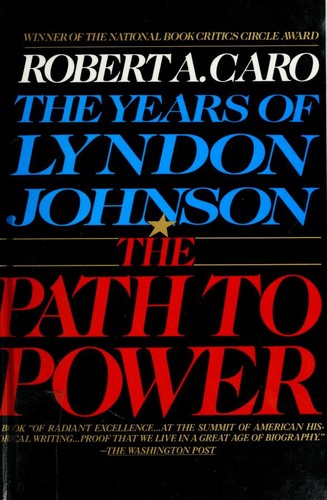
The Path to Power by Robert A. Caro is a 1982 biography book about power, ambition, texas. Ambition as compulsion is a recognizable but rarely analyzed psychological state. Johnson needed power the way other people need food, and the biography treats this as a clinical observation rather than a moral judgment.
Summary
The first volume of Robert A. Caro's multi-volume biography of Lyndon Baines Johnson covers LBJ's impoverished childhood in the Texas Hill Country, his education at Southwest Texas State Teachers College, his early political life as a congressional aide, his first congressional race, and his years in the House of Representatives through to his first (failed) Senate campaign in 1941. It is simultaneously an intimate biography of Johnson's psychological formation and a broader history of Texas politics, rural poverty, and the New Deal's impact on a region that electricity had not yet reached.
The Hill Country chapters are among the most extraordinary in American biographical literature. Caro spent years in the region, interviewing surviving residents who remembered what life was like before the Rural Electrification Administration brought power to the farms, and his account of that pre-electrical existence — the water hauling, the isolation, the particular misery of farmwives who pumped water by hand and cooked over wood stoves in summer heat — gives the New Deal's achievement a human weight that statistics cannot. When Lyndon Johnson as a congressman brought electricity to the Hill Country, Caro shows exactly what that meant to the people who received it.
Johnson himself emerges as one of the most complex figures in American political biography: brilliantly intelligent, constitutionally incapable of telling the truth when a lie would serve his purposes, plagued by an insecurity so deep that no amount of power could address it, capable of both genuine kindness and calculated cruelty, driven by an ambition that required understanding as a compulsion rather than a choice. Caro traces these qualities to Johnson's relationship with his father Sam, a failed Texas politician, and to the shame of having grown up in relative poverty in a region where poverty was universal.
The electoral corruption chapters — Johnson's fraud in the 1941 Senate primary is documented in detail — set a pattern that would recur in his 1948 election and in the compromises of his congressional career. Caro is not moralistic about Johnson's dishonesty; he treats it as a fact to be understood rather than condemned. The biography's implicit argument is that understanding LBJ requires holding simultaneously his genuine achievements on behalf of the poor and his systematic dishonesty in acquiring the power to achieve them.
Talk to The Path to Power like its author wrote you back.
Get the ideas that fit your life — not generic summaries.
- Chat with the book
- Audiobook-style main ideas
- Adapts to your life and goals
- Helps you take action
Key takeaways
- 1.
Ambition as compulsion is a recognizable but rarely analyzed psychological state. Johnson needed power the way other people need food, and the biography treats this as a clinical observation rather than a moral judgment.
- 2.
Rural poverty in 1930s Texas was a specific and severe condition with physical realities — water, heat, isolation — that urban readers in the twenty-first century need to have made tangible.
- 3.
The New Deal was not an abstract policy. For the Hill Country, electrification was a transformation in the conditions of daily life that Caro renders with specificity that makes the achievement real.
- 4.
Political power requires understanding procedural levers that most citizens and many politicians do not know exist. Johnson's mastery of congressional procedure began very early and was the foundation of his later effectiveness.
- 5.
Systematic dishonesty and genuine public service can coexist. Johnson stole elections and built schools; the biography refuses to resolve the tension.
- 6.
The relationship between a man's childhood and his adult psychology is never simple, but Caro's account of Johnson's Hill Country formation is the most persuasive argument I have seen for the childhood-as-explanation theory.
- 7.
Research creates empathy. Caro's method — living in the Hill Country, interviewing surviving residents, approaching subjects through local knowledge — generates portraits of place and person that desk research cannot.
- 8.
Power reveals character rather than creating it. The qualities Johnson would display at the height of his power — the manipulation, the generosity, the insecurity, the effectiveness — were all present in the congressional aide in his twenties.
Discussion questions
Use these on your own, with a book club, or as chat starters in Superbook. Book club version, ready to copy or print →
- 1.
Caro treats Johnson's dishonesty as a fact to be understood rather than condemned. Do you find that approach appropriate, or does it risk minimizing the harm caused by the lies?
- 2.
The Hill Country sections are the most unexpected in a political biography. Why does Caro spend so much time on a region rather than on the man?
- 3.
Johnson stole the 1941 Senate primary. How does the biography prepare you for that revelation, and how do you weigh it against his legislative achievements?
- 4.
The relationship between Johnson and his father Sam is presented as central to his psychological formation. How persuasive do you find Caro's account of that influence?
- 5.
Caro has been working on the LBJ biography since 1975. The fifth volume is still unfinished. What does that scale of commitment produce that a more conventional multi-year project cannot?
- 6.
Johnson's congressional career in the 1940s is the subject of material that is more difficult to dramatize than the Hill Country poverty sections. How does Caro manage that difficulty?
- 7.
The book contains extended digressions — on Texas history, on the New Deal's implementation, on specific political figures — that are essential to its argument. Do you find them absorbing or distracting?
- 8.
How does Volume 1 of a multi-volume biography work as a reading experience on its own? Does it feel complete?
- 9.
What does Caro's portrait of Johnson suggest about the relationship between ambition and democratic governance?
- 10.
Johnson's treatment of subordinates is already visible in his congressional aide years. What does that behavior suggest about power and accountability?
- 11.
Is there something specifically American about the story Caro is telling — about ambition, power, and the country's self-image?
Themes
Frequently asked questions
-
Do I need to read The Path to Power before the other LBJ volumes?
Technically no, but the later volumes assume the psychological foundation that Volume 1 establishes. Most readers find that starting from the beginning produces the deepest understanding of why Johnson became what he became.
-
How long does The Path to Power take to read?
About twenty to twenty-five hours. At over 800 pages it is formidable, but Caro's prose is accessible and his narrative drive is strong. The Hill Country sections in particular move quickly despite their historical depth.
-
Is LBJ portrayed sympathetically?
Not exactly. Caro is scrupulously fair in the sense that he documents Johnson's achievements and failures with equal care. But the Johnson who emerges — dishonest, insecure, driven — is not an easy figure to admire, even when his accomplishments are real.
-
What are the other volumes about?
Volume 2 covers Johnson's Senate years and the 1948 election; Volume 3 covers his Senate leadership; Volume 4 covers his vice presidency and Kennedy assassination; Volume 5, still unfinished, is expected to cover the full Great Society and Vietnam years.
-
Is the series appropriate for general readers or primarily for political historians?
General readers. Caro writes for a broad audience and contextualizes everything that requires contextualizing. Political historians read it; so do readers who have never read political biography before.
Similar books
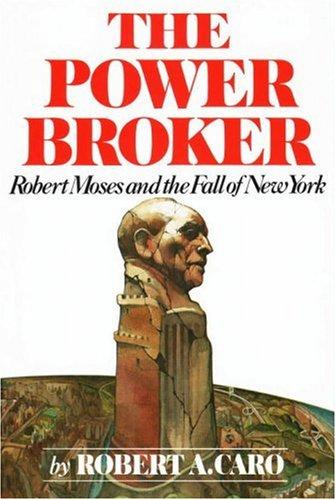
The Power Broker: Robert Moses and the Fall of New York
Robert A. Caro
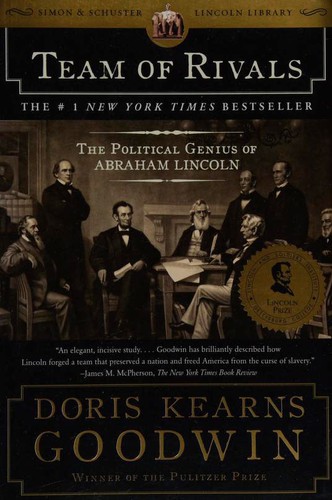
Team of Rivals: The Political Genius of Abraham Lincoln
Doris Kearns Goodwin
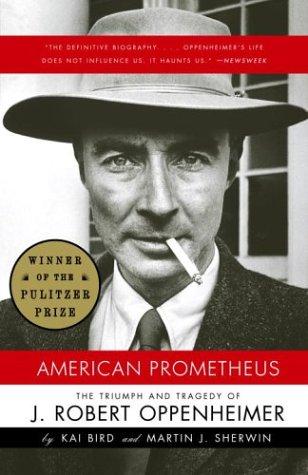
American Prometheus
Kai Bird and Martin J. Sherwin
