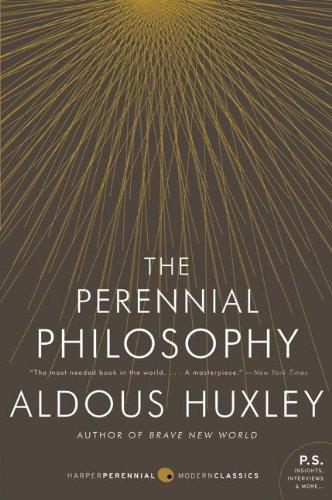
Talk to The Perennial Philosophy like its author wrote you back.
Get the ideas that fit your life — not generic summaries.
- Chat with the book
- Audiobook-style main ideas
- Adapts to your life and goals
- Helps you take action
What it argues
The Perennial Philosophy is Aldous Huxley's anthology and commentary on the mystical traditions of the world, arguing that behind the diversity of religious forms lies a single metaphysical core: the divine ground or ultimate reality is one; the human soul contains a spark of this reality; the purpose of human existence is to realize this identity; and the path to that realization requires ego-transcendence through contemplation, virtue, and love. This "highest common factor" — the perennial philosophy of the title — is found, Huxley claims, in Hindu Vedanta, Christian mysticism, Sufi Islam, Taoism, and Buddhist practice alike.
The book consists of short extracts from mystical texts across traditions, surrounded by Huxley's commentary. The organization is thematic rather than historical: chapters on the nature of the divine, the self and ego, eternity and time, prayer and contemplation, suffering, and the good life. Huxley draws on an extraordinarily wide range of sources: Meister Eckhart, Ramakrishna, the Bhagavad Gita, St. John of the Cross, the Tao Te Ching, the Sufi poets, the Desert Fathers, William Blake, and many others. The juxtapositions are often illuminating, revealing genuine convergences beneath very different vocabularies.
What it gets right
- 1.
The perennial philosophy identifies a single metaphysical core across the world's mystical traditions: the divine ground is one, the soul contains a spark of it, and the goal is realizing that identity.
- 2.
Mystical traditions within each religion converge on direct experience in a way that exoteric doctrines do not — the experiential core is more universal than the institutional forms.
- 3.
Ego-transcendence — the voluntary surrender of the separate self — is the precondition of genuine mystical experience across traditions.
What it covers
Who wrote it
Aldous Huxley (1894–1963) was a British novelist, essayist, and philosopher best known for his dystopian novel Brave New World (1932). Born into a distinguished scientific and literary family, he turned increasingly toward mysticism and consciousness studies in the second half of his life. The Perennial Philosophy (1945), The Doors of Perception (1954), and his final novel Island (1962) reflect his sustained inquiry into contemplative practice, psychedelic experience, and the question of how human civilization might be reorganized around deeper forms of awareness. He died on November 22, 1963, the same day as C. S. Lewis and John F. Kennedy.
