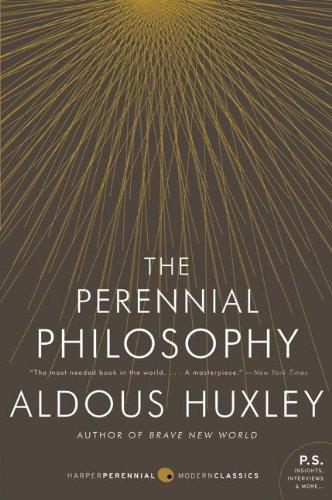
The Perennial Philosophy by Aldous Huxley is a 1945 religion & spirituality book about mysticism, divine unity, comparative religion. The perennial philosophy identifies a single metaphysical core across the world's mystical traditions: the divine ground is one, the soul contains a spark of it, and the goal is realizing that identity.
Summary
The Perennial Philosophy is Aldous Huxley's anthology and commentary on the mystical traditions of the world, arguing that behind the diversity of religious forms lies a single metaphysical core: the divine ground or ultimate reality is one; the human soul contains a spark of this reality; the purpose of human existence is to realize this identity; and the path to that realization requires ego-transcendence through contemplation, virtue, and love. This "highest common factor" — the perennial philosophy of the title — is found, Huxley claims, in Hindu Vedanta, Christian mysticism, Sufi Islam, Taoism, and Buddhist practice alike.
The book consists of short extracts from mystical texts across traditions, surrounded by Huxley's commentary. The organization is thematic rather than historical: chapters on the nature of the divine, the self and ego, eternity and time, prayer and contemplation, suffering, and the good life. Huxley draws on an extraordinarily wide range of sources: Meister Eckhart, Ramakrishna, the Bhagavad Gita, St. John of the Cross, the Tao Te Ching, the Sufi poets, the Desert Fathers, William Blake, and many others. The juxtapositions are often illuminating, revealing genuine convergences beneath very different vocabularies.
The argument is not that all religions are the same — Huxley is too precise for that. Rather, that the contemplative traditions within each religion converge on a core of direct experience that differs from the exoteric, institutional, and doctrinal dimensions of each tradition. The person who has experienced the divine ground directly, whatever their tradition, describes something recognizable across traditions in a way that dogmatic theologians often do not.
The Perennial Philosophy has been criticized for selecting texts that confirm its thesis while ignoring the ways traditions are genuinely incommensurable, and for privileging the mystical over the prophetic dimensions of religion. These criticisms have merit. But as an act of creative comparative reading and as an argument that the world's contemplative traditions contain wisdom that modernity has largely lost, it remains one of the most stimulating books of the 20th century.
Talk to The Perennial Philosophy like its author wrote you back.
Get the ideas that fit your life — not generic summaries.
- Chat with the book
- Audiobook-style main ideas
- Adapts to your life and goals
- Helps you take action
Key takeaways
- 1.
The perennial philosophy identifies a single metaphysical core across the world's mystical traditions: the divine ground is one, the soul contains a spark of it, and the goal is realizing that identity.
- 2.
Mystical traditions within each religion converge on direct experience in a way that exoteric doctrines do not — the experiential core is more universal than the institutional forms.
- 3.
Ego-transcendence — the voluntary surrender of the separate self — is the precondition of genuine mystical experience across traditions.
- 4.
Contemplation, virtue, and love are the three pathways to realization identified consistently across Christian, Hindu, Buddhist, and Sufi sources.
- 5.
The divine is simultaneously immanent (present in all things) and transcendent (beyond all things) — the two are complementary, not contradictory.
- 6.
Time and eternity are not opposed but nested: eternity is not endless time but the ground that contains and sustains temporal experience.
- 7.
The goal of mystical practice is not escape from the world but a transformed relationship to it — acting from the standpoint of divine ground rather than ego.
- 8.
Modern Western culture has systematically marginalized the contemplative dimension of human experience, to significant cost.
Discussion questions
Use these on your own, with a book club, or as chat starters in Superbook. Book club version, ready to copy or print →
- 1.
Huxley argues that behind the diversity of religious forms lies a single core. Is the evidence for that convergence compelling, or does it depend on selective reading?
- 2.
He distinguishes the contemplative dimensions of religion from the exoteric, institutional, and doctrinal dimensions. Is that distinction as clean as the book suggests?
- 3.
The perennial philosophy privileges mystical experience as the standard by which religious traditions are evaluated. What gets lost in that framing?
- 4.
Which of the mystical sources quoted resonated most with you? Why that one rather than another?
- 5.
Huxley argues that ego-transcendence is the central requirement of genuine spiritual practice. Is that claim compatible with a healthy sense of self, or does it require its demolition?
- 6.
The book was written during World War II. Does knowing that context change how you read the argument for a universal spiritual core beneath conflicting traditions?
- 7.
Huxley later experimented with mescaline and wrote The Doors of Perception, arguing that psychedelics can induce mystical experience. Does that supplement or undermine the argument in this book?
- 8.
The book largely ignores the prophetic and political dimensions of religion — the tradition of justice, liberation, and historical action. Is that a significant absence?
- 9.
Is the perennial philosophy itself a kind of ideology — a particular intellectual framework masquerading as universal truth?
- 10.
How does Huxley's account of contemplation compare to secular mindfulness practice? What does the mystical framing add or require?
- 11.
The book ends with a vision of a culture organized around the perennial philosophy. What would the practical implications of that be?
Themes
Frequently asked questions
-
What is the perennial philosophy?
The claim that the world's mystical traditions share a single metaphysical core: ultimate reality is one; the human soul participates in that reality; the purpose of life is to realize this; and the path involves ego-transcendence through contemplation, virtue, and love. Huxley finds this core across Hindu, Buddhist, Christian, Sufi, and Taoist sources.
-
Is this book hostile to organized religion?
Not exactly. Huxley values the contemplative traditions within each religion while being critical of institutional, exoteric, and dogmatic religion. He is not attacking religion but arguing that its deepest resources have been marginalized.
-
How difficult is The Perennial Philosophy?
Moderate. The prose is clear and the format — short extracts with commentary — makes it accessible. But the breadth of source material is demanding, and readers unfamiliar with any of the traditions will need patience. A background in either Christian mysticism or Hindu Vedanta helps considerably.
-
What is the best way to read this book?
Slowly and thematically rather than sequentially. It rewards reading a chapter, sitting with it, and returning. The extract-and-commentary format makes it possible to enter at any point.
-
How has this book been received academically?
With significant criticism for its selective reading of sources and its assumption of a universal mystical core that many scholars dispute. Philosophers of religion like Steven Katz have argued that mystical experience is always shaped by doctrinal context and cannot be stripped of it. The debate is ongoing.
Similar books
The Varieties of Religious Experience
William James
The Bhagavad Gita
Anonymous
Waking Up: A Guide to Spirituality Without Religion
Sam Harris
The Idea of the Holy
Rudolf Otto
