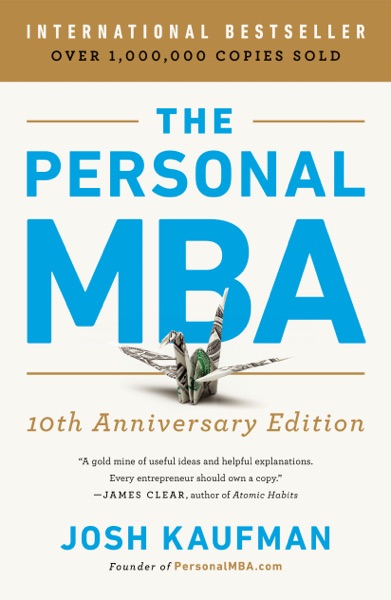
Talk to The Personal MBA: Master the Art of Business like its author wrote you back.
Get the ideas that fit your life — not generic summaries.
- Chat with the book
- Audiobook-style main ideas
- Adapts to your life and goals
- Helps you take action
The Personal MBA: Master the Art of Business, in detail
The Personal MBA makes a deliberately provocative claim: that the core concepts underlying business can be learned through self-directed reading for a fraction of the cost of an MBA program, and that most of what business schools teach is either available in books or not taught at all. Josh Kaufman spent years building a personal reading curriculum to fill in the business knowledge he lacked, and this book is his attempt to distill that curriculum into a single reference covering value creation, marketing, sales, operations, finance, and the psychology of working with people.
The book is organized as a series of mental models — short, named concepts that Kaufman argues are the building blocks of business thinking. Examples range from familiar ideas like supply and demand and sunk costs to less commonly named concepts like the Iteration Cycle, the Critical Assumptions test, and the Pricing Uncertainty Principle. Each concept gets a few pages. The format is deliberately encyclopedic; the book is more useful as a reference than as a narrative.
Kaufman's treatment of core business mechanics is solid and accessible. The sections on value creation — explaining the five types of value that businesses can offer and what makes each sustainable — are particularly useful for people at the beginning of their business thinking. The finance section covers enough accounting and cash flow basics to read a P&L without becoming a textbook. The psychology and human systems sections are where the book most clearly shows its self-help roots; they borrow heavily from cognitive science and productivity literature.
The book's main limitation is breadth at the expense of depth. Kaufman covers roughly 200 mental models; few receive more than a page of treatment. Readers with significant business experience will find much of it familiar, and some sections — particularly on sales and negotiation — are thinner than the dedicated books on those topics. But as a starting framework for someone trying to build business literacy efficiently, the Personal MBA remains one of the more coherent attempts to map the terrain. The anti-MBA framing is a marketing hook, but the underlying project of identifying which concepts actually matter is genuinely useful.
The big ideas
- 1.
Every business performs five core processes: value creation, marketing, sales, value delivery, and finance. Understanding what each requires is the foundation of business literacy.
- 2.
There are five types of value a business can offer: products, services, shared resources, subscriptions, and resales. Each has different economics and different competitive dynamics.
- 3.
Testing Critical Assumptions — the beliefs your business depends on that might not be true — is more important than perfecting a plan. Find out cheaply what will or won't work.
