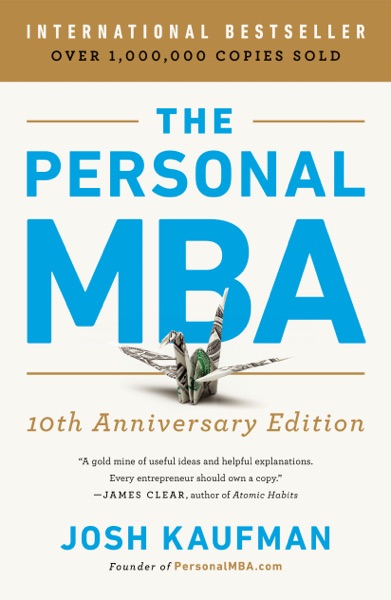
The Personal MBA: Master the Art of Business by Josh Kaufman is a 2010 business book about business fundamentals, self-education, entrepreneurship. Every business performs five core processes: value creation, marketing, sales, value delivery, and finance. Understanding what each requires is the foundation of business literacy.
Summary
The Personal MBA makes a deliberately provocative claim: that the core concepts underlying business can be learned through self-directed reading for a fraction of the cost of an MBA program, and that most of what business schools teach is either available in books or not taught at all. Josh Kaufman spent years building a personal reading curriculum to fill in the business knowledge he lacked, and this book is his attempt to distill that curriculum into a single reference covering value creation, marketing, sales, operations, finance, and the psychology of working with people.
The book is organized as a series of mental models — short, named concepts that Kaufman argues are the building blocks of business thinking. Examples range from familiar ideas like supply and demand and sunk costs to less commonly named concepts like the Iteration Cycle, the Critical Assumptions test, and the Pricing Uncertainty Principle. Each concept gets a few pages. The format is deliberately encyclopedic; the book is more useful as a reference than as a narrative.
Kaufman's treatment of core business mechanics is solid and accessible. The sections on value creation — explaining the five types of value that businesses can offer and what makes each sustainable — are particularly useful for people at the beginning of their business thinking. The finance section covers enough accounting and cash flow basics to read a P&L without becoming a textbook. The psychology and human systems sections are where the book most clearly shows its self-help roots; they borrow heavily from cognitive science and productivity literature.
The book's main limitation is breadth at the expense of depth. Kaufman covers roughly 200 mental models; few receive more than a page of treatment. Readers with significant business experience will find much of it familiar, and some sections — particularly on sales and negotiation — are thinner than the dedicated books on those topics. But as a starting framework for someone trying to build business literacy efficiently, the Personal MBA remains one of the more coherent attempts to map the terrain. The anti-MBA framing is a marketing hook, but the underlying project of identifying which concepts actually matter is genuinely useful.
Talk to The Personal MBA: Master the Art of Business like its author wrote you back.
Get the ideas that fit your life — not generic summaries.
- Chat with the book
- Audiobook-style main ideas
- Adapts to your life and goals
- Helps you take action
Key takeaways
- 1.
Every business performs five core processes: value creation, marketing, sales, value delivery, and finance. Understanding what each requires is the foundation of business literacy.
- 2.
There are five types of value a business can offer: products, services, shared resources, subscriptions, and resales. Each has different economics and different competitive dynamics.
- 3.
Testing Critical Assumptions — the beliefs your business depends on that might not be true — is more important than perfecting a plan. Find out cheaply what will or won't work.
- 4.
The Pricing Uncertainty Principle: you cannot know in advance the optimal price for your offer. Real pricing knowledge comes from market testing, not from theory.
- 5.
Four ways to increase revenue: more customers, higher prices, more transactions per customer, higher transaction value. Most businesses only pursue the first.
- 6.
Sunk costs are irrelevant to future decisions. What you've already spent or invested should not determine what you do next — only future costs and benefits matter.
- 7.
Self-education is a competitive advantage. The gap between what business schools teach and what practitioners actually need creates an opportunity for anyone willing to read systematically.
- 8.
Human systems — how people communicate, make decisions, and coordinate — are as important to a business's outcomes as its financial or operational systems.
Discussion questions
Use these on your own, with a book club, or as chat starters in Superbook. Book club version, ready to copy or print →
- 1.
Kaufman argues that self-directed reading can substitute for an MBA. Where do you think that claim holds up, and where does the analogy break down?
- 2.
The five core business processes are value creation, marketing, sales, delivery, and finance. Which of these do you understand best in your own organization, and which is most opaque to you?
- 3.
What are the Critical Assumptions — the beliefs your current work depends on — that you have never explicitly tested?
- 4.
Kaufman says most businesses only pursue one of the four revenue-growth levers. Which lever does your organization focus on, and which of the others is most worth exploring?
- 5.
The book is organized as mental models rather than as a narrative. Does that format help you or make the ideas harder to retain?
- 6.
How much of the business knowledge you've accumulated came from formal education versus direct experience? Which was more useful?
- 7.
Kaufman argues that sunk costs are irrelevant to future decisions. Think of a recent situation where sunk-cost thinking affected a decision in your organization. What was the cost?
- 8.
The book covers psychology and human behavior alongside finance and operations. Are those genuinely part of 'business literacy,' or does bundling them together dilute both?
- 9.
What's missing from the Personal MBA curriculum that you think is essential to understand business well?
- 10.
If you had to identify the three mental models from this book most applicable to your work right now, what would they be?
- 11.
Kaufman argues for testing assumptions cheaply before committing resources. What assumption in your current work deserves a cheap test before you invest further?
- 12.
The anti-MBA framing is provocative. Does it affect how seriously you take the book, positively or negatively?
Themes
Frequently asked questions
-
Is The Personal MBA worth reading for someone with an actual MBA?
Depends on how you approach it. For someone with business experience, most of the foundational content will be familiar. The value is in the taxonomy — Kaufman names and frames concepts in ways that can clarify thinking even if you already know the underlying ideas. It works better as a reference than a cover-to-cover read for experienced practitioners.
-
What is The Personal MBA actually about?
It's a reference covering the core concepts of business — value creation, marketing, sales, operations, finance, and human psychology — organized as a set of named mental models. The premise is that self-directed study can substitute for formal business education.
-
Is the anti-MBA claim credible?
As a learning strategy, it's reasonable for self-motivated readers. MBA programs also provide credentials, networks, and structured experience that a reading list can't replicate. Kaufman is making a learning argument, not a career strategy argument, and on those narrower terms the case is defensible.
-
Who should read The Personal MBA?
People early in their business careers who want a conceptual map of how businesses work. Also useful for technical practitioners — engineers, designers, scientists — who want business literacy without committing to a graduate degree.
-
How long does The Personal MBA take to read?
About seven to eight hours at average reading pace. The chapters are short and self-contained, which makes it easy to read in sections. Most readers find it better to use it as a reference after an initial read-through rather than rereading linearly.
Similar books

Rework
Jason Fried and David Heinemeier Hansson
Zero to One: Notes on Startups, or How to Build the Future
Peter Thiel
The E-Myth Revisited
Michael E. Gerber
Good Strategy Bad Strategy
Richard Rumelt
