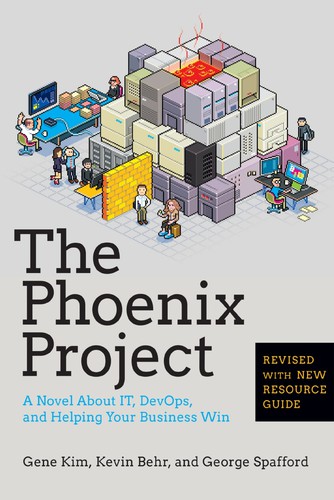
Talk to The Phoenix Project: A Novel About IT, DevOps, and Helping Your Business Win like its author wrote you back.
Get the ideas that fit your life — not generic summaries.
- Chat with the book
- Audiobook-style main ideas
- Adapts to your life and goals
- Helps you take action
The Phoenix Project: A Novel About IT, DevOps, and Helping Your Business Win, in detail
The Phoenix Project is a business novel — structured like The Goal, which it explicitly acknowledges — that applies the Theory of Constraints and lean manufacturing principles to IT operations and software delivery. The protagonist, Bill Palmer, is unexpectedly promoted to VP of IT Operations at a struggling manufacturing company and given ninety days to rescue a critical software project that has gone catastrophically over budget and schedule. What he discovers is that the problems are not technical — they are organizational, systems-level, and fundamentally about how work flows through the IT organization.
The novel's intellectual guide, Erik, introduces Bill to the Three Ways: the first way is systems thinking — understanding IT as a complete flow of work from business need to delivered value, not as a collection of isolated teams and projects. The second way is amplifying feedback loops — shortening the time it takes for problems to surface and for fixes to be validated. The third way is creating a culture of continual experimentation and learning, where failures are learning opportunities rather than events to be avoided or concealed.
The book draws an explicit parallel to lean manufacturing: work in IT flows like work in a factory, and the same constraint analysis that Goldratt applied to production lines applies to software delivery pipelines. The identification of the four types of work — business projects, internal IT projects, changes, and unplanned work — and the realization that unplanned work destroys planned work more than any other factor is one of the book's most practically useful contributions.
The Phoenix Project was instrumental in popularizing the DevOps movement, which applies these ideas to the specific challenge of making software development and operations work better together. The novel format makes the ideas accessible to a broad audience, including business leaders who have never written a line of code. The honest limitation: the manufacturing plant analogies occasionally strain under the differences between software and physical production, and some readers find the protagonist's rapid comprehension of complex organizational dynamics implausible.
The big ideas
- 1.
The Three Ways of DevOps: systems thinking (optimize the whole flow, not local parts), feedback loops (surface problems fast), and continual experimentation and learning.
- 2.
The four types of work in IT: business projects, internal IT projects, changes, and unplanned work. Unplanned work is the most destructive — it displaces planned work and makes commitments unreliable.
- 3.
Every constraint in the IT pipeline creates a bottleneck that accumulates work. Improving throughput at non-constraints without improving the constraint makes the constraint worse, not better.
