The Phoenix Project: A Novel About IT, DevOps, and Helping Your Business Win by Gene Kim, Kevin Behr, and George Spafford is a 2013 business book about operations, technology, systems thinking. The Three Ways of DevOps: systems thinking (optimize the whole flow, not local parts), feedback loops (surface problems fast), and continual experimentation and learning.
Summary
The Phoenix Project is a business novel — structured like The Goal, which it explicitly acknowledges — that applies the Theory of Constraints and lean manufacturing principles to IT operations and software delivery. The protagonist, Bill Palmer, is unexpectedly promoted to VP of IT Operations at a struggling manufacturing company and given ninety days to rescue a critical software project that has gone catastrophically over budget and schedule. What he discovers is that the problems are not technical — they are organizational, systems-level, and fundamentally about how work flows through the IT organization.
The novel's intellectual guide, Erik, introduces Bill to the Three Ways: the first way is systems thinking — understanding IT as a complete flow of work from business need to delivered value, not as a collection of isolated teams and projects. The second way is amplifying feedback loops — shortening the time it takes for problems to surface and for fixes to be validated. The third way is creating a culture of continual experimentation and learning, where failures are learning opportunities rather than events to be avoided or concealed.
The book draws an explicit parallel to lean manufacturing: work in IT flows like work in a factory, and the same constraint analysis that Goldratt applied to production lines applies to software delivery pipelines. The identification of the four types of work — business projects, internal IT projects, changes, and unplanned work — and the realization that unplanned work destroys planned work more than any other factor is one of the book's most practically useful contributions.
The Phoenix Project was instrumental in popularizing the DevOps movement, which applies these ideas to the specific challenge of making software development and operations work better together. The novel format makes the ideas accessible to a broad audience, including business leaders who have never written a line of code. The honest limitation: the manufacturing plant analogies occasionally strain under the differences between software and physical production, and some readers find the protagonist's rapid comprehension of complex organizational dynamics implausible.
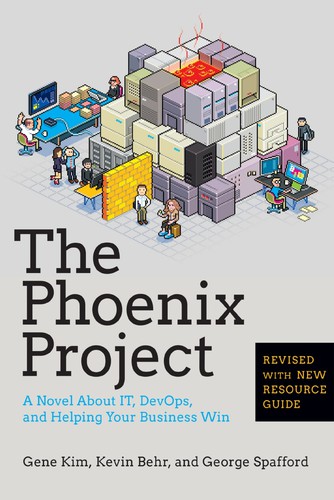
Talk to The Phoenix Project: A Novel About IT, DevOps, and Helping Your Business Win like its author wrote you back.
Get the ideas that fit your life — not generic summaries.
- Chat with the book
- Audiobook-style main ideas
- Adapts to your life and goals
- Helps you take action
Key takeaways
- 1.
The Three Ways of DevOps: systems thinking (optimize the whole flow, not local parts), feedback loops (surface problems fast), and continual experimentation and learning.
- 2.
The four types of work in IT: business projects, internal IT projects, changes, and unplanned work. Unplanned work is the most destructive — it displaces planned work and makes commitments unreliable.
- 3.
Every constraint in the IT pipeline creates a bottleneck that accumulates work. Improving throughput at non-constraints without improving the constraint makes the constraint worse, not better.
- 4.
Technical debt is the accumulation of short-term fixes and deferred maintenance. Like financial debt, it accrues interest — the longer you carry it, the more it costs to service and eventually repay.
- 5.
Change management done poorly is one of the biggest sources of unplanned work and outages. Most IT failures are caused by changes, and most of those are poorly understood or untested.
- 6.
The constraint in most IT organizations is not development capacity — it is the flow of work through the deployment pipeline, including approval processes, testing, and production release.
- 7.
Visualizing work — using boards, queues, and flow metrics — makes the hidden constraints visible and allows the organization to intervene before backlogs become crises.
- 8.
IT is not a cost center to be minimized — it is a business capability that enables or limits the speed of competitive response. How quickly an organization can deliver software changes is increasingly a strategic variable.
Discussion questions
Use these on your own, with a book club, or as chat starters in Superbook. Book club version, ready to copy or print →
- 1.
Kim and his co-authors model The Phoenix Project directly on The Goal. What does the novel format add to the transmission of management ideas compared to a traditional business book?
- 2.
What is unplanned work in your own organization, and how much of your team's capacity does it consume? What would change if you made it visible and managed it explicitly?
- 3.
The book argues that IT failures are organizational problems, not technical ones. Have you seen IT problems that were attributed to technology but were actually caused by process or management?
- 4.
The four types of work — business projects, internal projects, changes, and unplanned work — are rarely tracked separately in most organizations. Why not, and what would you learn if you did?
- 5.
Technical debt is compared to financial debt: it accrues interest over time. How do you communicate the cost of technical debt to business stakeholders who aren't technical?
- 6.
Erik introduces the Three Ways. Which of the three is most underdeveloped in a technology organization you know — systems thinking, feedback loops, or continual learning?
- 7.
The DevOps movement has been highly influential since this book was published in 2013. What has changed in how organizations implement these ideas, and what remains persistently difficult?
- 8.
How do you identify the constraint in a software delivery pipeline? What are the observable symptoms of a constrained deployment process?
- 9.
The Phoenix Project focuses on a traditional IT department. How does the framework apply to a pure software company that is entirely in the business of building and shipping software?
- 10.
Change management is the most common cause of IT failures according to the book. What does effective change management look like, and how do you balance rigor with the speed that business stakeholders demand?
- 11.
What is the relationship between the DevOps principles in The Phoenix Project and lean manufacturing? Where do the analogies hold, and where do they break down?
Themes
Frequently asked questions
-
Do I need a technical background to understand The Phoenix Project?
No. The novel format is specifically designed to be accessible to non-technical business leaders. Bill Palmer's perspective as a non-technical VP is partly the point — the ideas are operational and organizational, not technical.
-
What is DevOps?
A set of practices and a cultural philosophy aimed at making software development and IT operations work together more effectively. The Phoenix Project is the most widely read popularization of DevOps principles, though the term predates the book by a few years.
-
How does The Phoenix Project relate to The Goal?
The Phoenix Project explicitly models itself on The Goal and applies Goldratt's Theory of Constraints to IT operations. The three-way relationship — a protagonist in crisis, a Socratic guide, and a ninety-day deadline — is directly parallel. Understanding The Goal enriches the reading.
-
What should I read after The Phoenix Project?
The DevOps Handbook by Kim and his co-authors provides detailed implementation guidance. Accelerate by Nicole Forsgren, Jez Humble, and Kim presents research on what high-performing software organizations actually do differently. The Unicorn Project is Gene Kim's 2019 sequel focused on developers.
-
Is The Phoenix Project relevant for non-IT managers?
Yes. The core ideas — constraint analysis, flow of work, feedback loops, and reducing unplanned work — apply to any organization that delivers complex services or products through a multi-step process. IT is the metaphor; the principles are general.
Similar books

The Goal: A Process of Ongoing Improvement
Eliyahu M. Goldratt and Jeff Cox
Traction: Get a Grip on Your Business
Gino Wickman
The Lean Startup
Eric Ries
Good Strategy Bad Strategy
Richard Rumelt
