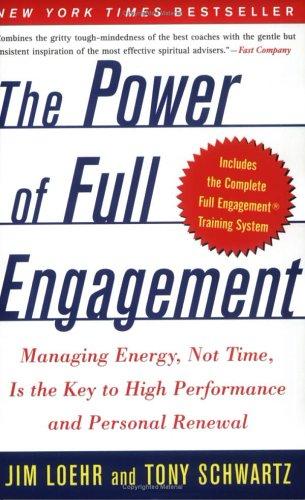
Talk to The Power of Full Engagement like its author wrote you back.
Get the ideas that fit your life — not generic summaries.
- Chat with the book
- Audiobook-style main ideas
- Adapts to your life and goals
- Helps you take action
The Power of Full Engagement, in detail
The Power of Full Engagement starts from a simple reframe: time is fixed, but energy is not. Loehr and Schwartz argue that the real limit on human performance isn't hours in the day but the capacity to bring full energy to what matters. They draw on decades of work training elite athletes and executives — the authors ran the Human Performance Institute in Florida — and the central observation is that high performers in both domains share one habit that average performers lack: they manage their recovery as deliberately as they manage their effort.
The book identifies four energy dimensions that have to be developed and protected: physical, emotional, mental, and spiritual. Physical energy is the foundation — sleep, nutrition, movement, and recovery rhythms. Emotional energy covers the quality of connection and mood regulation. Mental energy is focus, realistic optimism, and the ability to sustain attention without fragmentation. Spiritual energy, the deepest and most easily neglected, is alignment with purpose and values. All four can be expanded through training and depleted through misuse. The authors insist that stress is not the enemy — it's the stimulus that builds capacity — but stress without recovery is the actual problem.
The framework is explicit about a full-engagement cycle: a period of expenditure followed by a period of renewal. Loehr and Schwartz compare this to interval training: the body adapts and grows stronger through oscillation, not through continuous output. They apply the same logic to every energy level. A ninety-minute work block followed by a real break builds mental capacity in the same way sprint intervals build cardiovascular fitness. Skipping recovery — the grinding, always-on approach most knowledge workers default to — is the equivalent of lifting weights without rest days. You don't get stronger; you just accumulate damage.
The practical program involves two exercises: first, identifying the gap between the person you want to be and how you actually show up under pressure; second, building what the authors call "rituals" — precise, automatic behaviors that manage energy without relying on willpower. The book is at its best when it names the specific behaviors that drain each energy dimension and the concrete rituals that restore them. It is less useful for readers who already have structured recovery practices, and the corporate case studies read as somewhat dated. But the underlying model — that sustainable high performance requires full engagement, not full extension — holds up well and remains underused outside athletic training contexts.
The big ideas
- 1.
The fundamental problem with modern performance is not lack of time but lack of managed energy. Time is fixed; energy capacity can be built or depleted.
- 2.
Full engagement requires drawing on four energy dimensions: physical, emotional, mental, and spiritual. Neglecting any one of them creates an efficiency ceiling.
- 3.
Stress is not the enemy. Insufficient recovery is. Capacity grows through the oscillation of stress and renewal, not through unbroken output.
