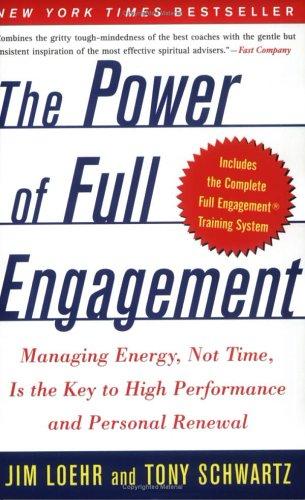
The Power of Full Engagement by Jim Loehr and Tony Schwartz is a 2003 self-help book about energy management, performance, recovery. The fundamental problem with modern performance is not lack of time but lack of managed energy. Time is fixed; energy capacity can be built or depleted.
Summary
The Power of Full Engagement starts from a simple reframe: time is fixed, but energy is not. Loehr and Schwartz argue that the real limit on human performance isn't hours in the day but the capacity to bring full energy to what matters. They draw on decades of work training elite athletes and executives — the authors ran the Human Performance Institute in Florida — and the central observation is that high performers in both domains share one habit that average performers lack: they manage their recovery as deliberately as they manage their effort.
The book identifies four energy dimensions that have to be developed and protected: physical, emotional, mental, and spiritual. Physical energy is the foundation — sleep, nutrition, movement, and recovery rhythms. Emotional energy covers the quality of connection and mood regulation. Mental energy is focus, realistic optimism, and the ability to sustain attention without fragmentation. Spiritual energy, the deepest and most easily neglected, is alignment with purpose and values. All four can be expanded through training and depleted through misuse. The authors insist that stress is not the enemy — it's the stimulus that builds capacity — but stress without recovery is the actual problem.
The framework is explicit about a full-engagement cycle: a period of expenditure followed by a period of renewal. Loehr and Schwartz compare this to interval training: the body adapts and grows stronger through oscillation, not through continuous output. They apply the same logic to every energy level. A ninety-minute work block followed by a real break builds mental capacity in the same way sprint intervals build cardiovascular fitness. Skipping recovery — the grinding, always-on approach most knowledge workers default to — is the equivalent of lifting weights without rest days. You don't get stronger; you just accumulate damage.
The practical program involves two exercises: first, identifying the gap between the person you want to be and how you actually show up under pressure; second, building what the authors call "rituals" — precise, automatic behaviors that manage energy without relying on willpower. The book is at its best when it names the specific behaviors that drain each energy dimension and the concrete rituals that restore them. It is less useful for readers who already have structured recovery practices, and the corporate case studies read as somewhat dated. But the underlying model — that sustainable high performance requires full engagement, not full extension — holds up well and remains underused outside athletic training contexts.
Talk to The Power of Full Engagement like its author wrote you back.
Get the ideas that fit your life — not generic summaries.
- Chat with the book
- Audiobook-style main ideas
- Adapts to your life and goals
- Helps you take action
Key takeaways
- 1.
The fundamental problem with modern performance is not lack of time but lack of managed energy. Time is fixed; energy capacity can be built or depleted.
- 2.
Full engagement requires drawing on four energy dimensions: physical, emotional, mental, and spiritual. Neglecting any one of them creates an efficiency ceiling.
- 3.
Stress is not the enemy. Insufficient recovery is. Capacity grows through the oscillation of stress and renewal, not through unbroken output.
- 4.
Physical energy is the foundation. Sleep, movement, and nutrition are not health choices peripheral to performance — they are the substrate on which all other energy depends.
- 5.
Spiritual energy, in Loehr and Schwartz's use, is not religious. It is alignment between daily behavior and deeply held values. When that alignment breaks down, engagement follows.
- 6.
Performance rituals automate energy management. Precise pre-performance behaviors reduce reliance on willpower and make full engagement repeatable rather than occasional.
- 7.
The ninety-minute ultradian rhythm maps onto natural human performance cycles. Working in focused blocks with real recovery between them mirrors how the body is already designed to function.
- 8.
The gap between who you want to be and how you actually behave under pressure is the diagnostic. That gap, not vague goals, is where the work begins.
Discussion questions
Use these on your own, with a book club, or as chat starters in Superbook. Book club version, ready to copy or print →
- 1.
Loehr and Schwartz say most people manage time rather than energy. Which energy dimension do you think you manage worst right now — physical, emotional, mental, or spiritual?
- 2.
The book argues that stress without recovery is the real problem, not stress itself. Where in your life have you been applying stress without giving yourself genuine recovery?
- 3.
Think about a time when you brought full engagement to something. What were the conditions that made that possible? Are those conditions present in your regular work?
- 4.
The authors use the term 'full extension' to describe the grinding, depleted state most people mistake for performance. Does that description fit your current approach to work?
- 5.
Physical energy is described as foundational. How seriously do you take sleep, nutrition, and movement as performance variables rather than just health variables?
- 6.
Spiritual energy in the book means alignment between values and daily behavior. What values do you hold most strongly? How closely does your day-to-day behavior reflect them?
- 7.
The ninety-minute work-and-recovery cycle is one of the book's most concrete recommendations. What would your day look like if you actually structured it around deliberate oscillation?
- 8.
What performance ritual — a precise, automatic behavior — would most predictably improve your energy in the first two hours of the day?
- 9.
The book was written largely from athletic training research. How well do you think that model transfers to knowledge work? Where does it fit cleanly and where does it break down?
- 10.
Loehr and Schwartz say recovery has to be real — not passive distraction like scrolling a phone, but genuine disengagement. What does actual recovery look like for you?
- 11.
The authors identify a gap between the person you want to be and how you actually behave under pressure. What specific situation reveals that gap most clearly in your own life?
- 12.
The book's corporate case studies are from the late 1990s and early 2000s. Which of the core arguments feel more relevant today than they did then, and which feel less so?
Themes
Frequently asked questions
-
What is The Power of Full Engagement about?
It argues that managing energy — not time — is the key to high performance. Loehr and Schwartz identify four energy dimensions (physical, emotional, mental, spiritual) and make the case that sustainable performance requires deliberate recovery as much as deliberate effort.
-
Is The Power of Full Engagement worth reading?
Yes, especially if you've been grinding through a long period of overwork without results. The energy-management framework is more durable than most productivity books. The corporate case studies feel dated, but the core model draws on real athletic training science and holds up.
-
How long does it take to read The Power of Full Engagement?
About four to four and a half hours at average reading pace. The chapters are short and built around case studies, so it moves quickly. The most practical section is the final quarter, where the ritual-building framework is laid out.
-
Who should read this book?
Knowledge workers, athletes, managers, and anyone who has noticed their performance declining in direct proportion to how hard they are pushing. It is particularly useful for people who have tried time-management systems and found they don't address the actual problem.
-
What is the most actionable idea in the book?
The ritual concept: instead of relying on willpower to show up fully, design precise pre-performance behaviors that automatically move you into the right state. Start small — one ritual per energy dimension — and make each one concrete enough that there is no decision to make in the moment.