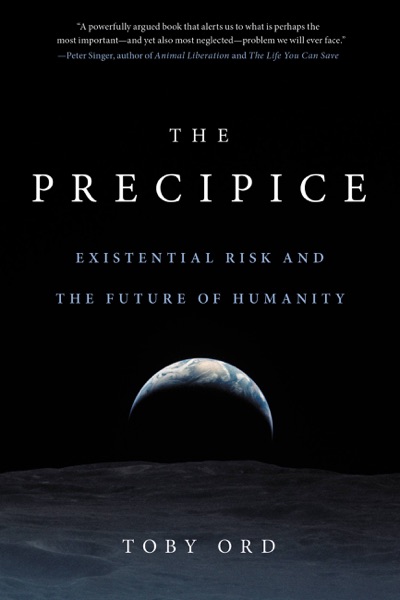
Talk to The Precipice: Existential Risk and the Future of Humanity like its author wrote you back.
Get the ideas that fit your life — not generic summaries.
- Chat with the book
- Audiobook-style main ideas
- Adapts to your life and goals
- Helps you take action
The Precipice: Existential Risk and the Future of Humanity, in detail
The Precipice is Oxford philosopher Toby Ord's case that humanity is living through an unusually dangerous period — one where our technological capabilities have outrun our wisdom and governance, and where a small number of risks could cut off not just this generation but all future generations. Ord's framing is explicitly moral: if humanity has any kind of long-term future, the potential value of that future is so large that even small reductions in existential risk are worth enormous effort and cost.
The first half of the book is an attempt to take existential risk seriously as an intellectual subject rather than a genre of science fiction. Ord distinguishes between risks that kill many people (catastrophic) and risks that permanently foreclose humanity's potential (existential). The latter category includes extinction, but also civilizational collapse so severe that recovery never occurs, or value lock-in under a permanent authoritarian regime. The historical survey — natural risks like asteroid impacts and supervolcanoes — establishes that natural existential risks are surprisingly small. The alarming risks are anthropogenic and modern: engineered pandemics, misaligned artificial general intelligence, nuclear war, climate-driven collapse.
Ord assigns rough probability estimates to each risk over the next century. He puts engineered pandemics and unaligned AI as the most significant contributors, with total existential risk he estimates at around one in six — the odds of Russian Roulette. He is careful about these estimates and acknowledges their uncertainty, but argues that even wide uncertainty bands leave the numbers large enough to demand serious response.
The second half turns practical. Ord argues that existential risk is a neglected cause: the scale of potential harm is vast, the current resources devoted to it are tiny, and tractable interventions exist. He lays out what better governance of dangerous technologies might look like and argues for longtermism — the idea that future people matter morally, and that because there are likely to be vastly more of them than us, their interests should weigh heavily in our decisions. The book is rigorously argued, written with unusual clarity for academic philosophy, and makes a strong case that what happens in the next few decades will echo across millennia.
The big ideas
- 1.
Existential risk is distinct from catastrophic risk: an existential catastrophe forecloses humanity's entire long-term potential, not just kills many people today.
- 2.
Natural existential risks — asteroids, supervolcanoes — are surprisingly low. The dominant risks this century are anthropogenic: engineered bioweapons, misaligned AI, nuclear war.
- 3.
Ord estimates total existential risk over the next century at roughly one in six — a number that demands serious response even under wide uncertainty about the inputs.
