The Precipice: Existential Risk and the Future of Humanity by Toby Ord is a 2020 philosophy book about existential risk, long-term future, humanity's potential. Existential risk is distinct from catastrophic risk: an existential catastrophe forecloses humanity's entire long-term potential, not just kills many people today.
Summary
The Precipice is Oxford philosopher Toby Ord's case that humanity is living through an unusually dangerous period — one where our technological capabilities have outrun our wisdom and governance, and where a small number of risks could cut off not just this generation but all future generations. Ord's framing is explicitly moral: if humanity has any kind of long-term future, the potential value of that future is so large that even small reductions in existential risk are worth enormous effort and cost.
The first half of the book is an attempt to take existential risk seriously as an intellectual subject rather than a genre of science fiction. Ord distinguishes between risks that kill many people (catastrophic) and risks that permanently foreclose humanity's potential (existential). The latter category includes extinction, but also civilizational collapse so severe that recovery never occurs, or value lock-in under a permanent authoritarian regime. The historical survey — natural risks like asteroid impacts and supervolcanoes — establishes that natural existential risks are surprisingly small. The alarming risks are anthropogenic and modern: engineered pandemics, misaligned artificial general intelligence, nuclear war, climate-driven collapse.
Ord assigns rough probability estimates to each risk over the next century. He puts engineered pandemics and unaligned AI as the most significant contributors, with total existential risk he estimates at around one in six — the odds of Russian Roulette. He is careful about these estimates and acknowledges their uncertainty, but argues that even wide uncertainty bands leave the numbers large enough to demand serious response.
The second half turns practical. Ord argues that existential risk is a neglected cause: the scale of potential harm is vast, the current resources devoted to it are tiny, and tractable interventions exist. He lays out what better governance of dangerous technologies might look like and argues for longtermism — the idea that future people matter morally, and that because there are likely to be vastly more of them than us, their interests should weigh heavily in our decisions. The book is rigorously argued, written with unusual clarity for academic philosophy, and makes a strong case that what happens in the next few decades will echo across millennia.
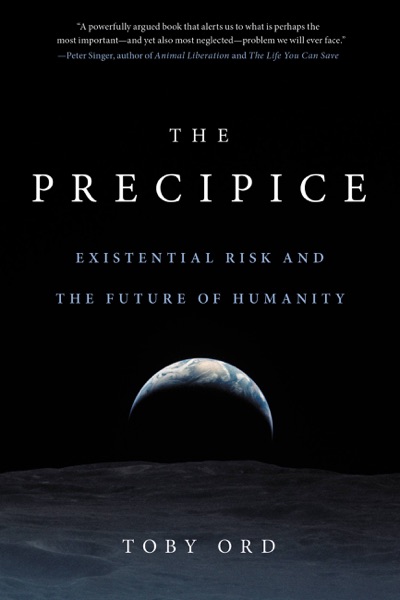
Talk to The Precipice: Existential Risk and the Future of Humanity like its author wrote you back.
Get the ideas that fit your life — not generic summaries.
- Chat with the book
- Audiobook-style main ideas
- Adapts to your life and goals
- Helps you take action
Key takeaways
- 1.
Existential risk is distinct from catastrophic risk: an existential catastrophe forecloses humanity's entire long-term potential, not just kills many people today.
- 2.
Natural existential risks — asteroids, supervolcanoes — are surprisingly low. The dominant risks this century are anthropogenic: engineered bioweapons, misaligned AI, nuclear war.
- 3.
Ord estimates total existential risk over the next century at roughly one in six — a number that demands serious response even under wide uncertainty about the inputs.
- 4.
Longtermism argues that future people matter morally, and because there may be far more future people than present ones, actions that improve long-term odds have enormous expected value.
- 5.
Existential risk is a neglected cause: the potential harm is vast, current resources are tiny, and tractable interventions exist in biosecurity, AI safety, and governance.
- 6.
The most dangerous scenario for AI is not a malevolent machine but a misaligned one — a system that pursues its objectives without adequate representation of human values.
- 7.
Value lock-in — the permanent capture of humanity's future by a narrow ideology or power — is itself an existential risk even if it doesn't cause extinction.
- 8.
The precipice metaphor is deliberate: Ord believes we are in an unusually risky period that will either be navigated or will determine the trajectory for all future generations.
Discussion questions
Use these on your own, with a book club, or as chat starters in Superbook. Book club version, ready to copy or print →
- 1.
Ord argues that the interests of future people should weigh heavily in our moral calculations. How does that principle square with the difficulty of knowing what future people will want?
- 2.
Does the one-in-six estimate for existential risk this century change how you think about current priorities — political, personal, or professional?
- 3.
Ord distinguishes between risks we can reduce and risks we can only accept. For which risks on his list does governance seem most tractable?
- 4.
The longtermist framework has been criticized for potentially justifying harms today for speculative future gains. Is that a fatal objection or a tractable problem?
- 5.
How does your intuition about AI risk compare with Ord's framing? Does 'misalignment' capture what you find genuinely worrying about powerful AI systems?
- 6.
Ord's treatment of value lock-in suggests that even a world with no extinction could be an existential catastrophe. What values, if locked in, would you consider existential failures?
- 7.
The book argues biosecurity is a neglected cause relative to its potential impact. What institutional features make some global risks systematically underfunded?
- 8.
How much moral weight do you give to people who will exist in the future versus people who exist now? Does your intuition shift when you try to reason about it explicitly?
- 9.
Ord acknowledges his probability estimates are highly uncertain. Does that uncertainty make the case for action weaker or stronger in your view?
- 10.
The Precipice argues we are living through a hinge of history. Does everyday experience confirm or undermine that sense for you?
- 11.
Which of the risks Ord surveys — engineered pandemics, AI, nuclear, climate — seems most amenable to collective action, and why?
- 12.
If existential risk reduction is as important as Ord argues, what does that imply for how talented people should allocate their careers?
Themes
Frequently asked questions
-
What is The Precipice about?
It's a philosophical and empirical examination of existential risk — the ways humanity could permanently foreclose its own long-term potential through extinction or civilizational catastrophe. Ord surveys natural and anthropogenic risks, estimates their probabilities, and argues for treating them as a moral priority.
-
Is The Precipice worth reading?
Yes, especially if you want a rigorous introduction to existential risk thinking rather than a popular-science treatment. The writing is unusually clear for academic philosophy and the moral framework is explicitly argued rather than assumed. Expect to disagree with parts — that's part of its value.
-
How long does it take to read The Precipice?
Roughly eight hours at average reading pace. The main text is about 250 pages, with substantial endnotes that are worth reading for the AI and biosecurity material.
-
What is longtermism, and is the book a defense of it?
Longtermism holds that future people matter morally and that, given how many future people there could be, improving long-term outcomes deserves enormous priority. The Precipice argues for a version of longtermism grounded in potential-preservation rather than the more radical utilitarian forms, and is generally considered one of the clearest defenses of the position.
-
Who should read The Precipice?
Policy-minded readers, students of philosophy or AI ethics, and anyone curious about how to reason about risks with very large stakes and high uncertainty. It's less useful for readers who want a purely technical treatment of any single risk — it's strongest as a moral and strategic framework.
Similar books
Superintelligence: Paths, Dangers, Strategies
Nick Bostrom
The Sixth Extinction: An Unnatural History
Elizabeth Kolbert
Human Compatible: Artificial Intelligence and the Problem of Control
Stuart Russell
A Crack in Creation: Gene Editing and the Unthinkable Power to Control Evolution
Jennifer A. Doudna and Samuel H. Sternberg
