Talk to Judgment Under Uncertainty: Heuristics and Biases like its author wrote you back.
Get the ideas that fit your life — not generic summaries.
- Chat with the book
- Audiobook-style main ideas
- Adapts to your life and goals
- Helps you take action
Judgment Under Uncertainty: Heuristics and Biases, in detail
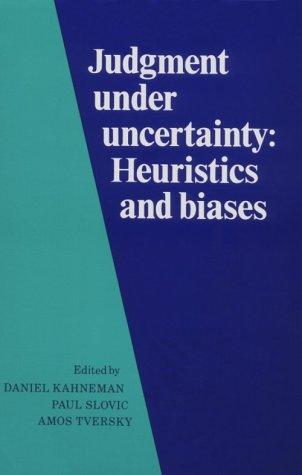
Judgment Under Uncertainty is the academic anthology that launched a research program. Edited by Daniel Kahneman, Paul Slovic, and Amos Tversky, it collects the foundational papers of what became the heuristics-and-biases literature — the body of work showing that human judgment under uncertainty systematically departs from the normative models of probability and rationality that economists and decision theorists had assumed. The book contains thirty-five papers, many now canonical, including Tversky and Kahneman's original work on representativeness, availability, and anchoring and adjustment.
The program's core finding is simple to state and surprising in its breadth: people do not calculate probabilities. Instead, they use cognitive shortcuts — heuristics — that are generally useful but produce predictable, systematic errors. Representativeness leads people to judge probability by how well something fits a prototype, ignoring base rates. Availability leads people to judge frequency by how easily examples come to mind, producing miscalibrated risk assessments. Anchoring and adjustment leads people to give too much weight to an initial number even when it is arbitrary. Each heuristic has a logic — they work well in most everyday situations — but in the specific conditions of probabilistic reasoning, they fail reliably and in identifiable ways.
The book is a primary source, not a popularization. It is organized into sections: representativeness, calibration, prediction, attribution, and risky choice. The papers vary in technical difficulty, but most are accessible to readers with no statistical background if they are willing to work through the examples. For readers who know Kahneman's Thinking, Fast and Slow, this anthology provides the scientific substance behind that book's narrative. Many of the famous studies — the conjunction fallacy, the Linda problem, base rate neglect, overconfidence — appear here in their original experimental form.
The limitations are those of any thirty-year-old anthology. Some findings have been refined or partially challenged by subsequent research. The ecological validity question — whether biases found in laboratory tasks with college students generalize to real-world expert judgment — has been contested by Gerd Gigerenzen and others. Nonetheless, the research program represented here transformed economics, medicine, law, and public policy, and the core findings about heuristics and their failures have proven robust. This is an essential text for anyone who wants to understand where behavioral economics and modern decision science came from.
The big ideas
- 1.
People judge probability using heuristics rather than calculating base rates. Representativeness, availability, and anchoring are the three primary heuristics Tversky and Kahneman identify, each with characteristic failure modes.
- 2.
Representativeness heuristic: we judge the probability that something belongs to a category by how well it resembles the category prototype, often neglecting base rate information that should dominate the calculation.
- 3.
Availability heuristic: we estimate frequency and probability by the ease with which examples come to mind. Vivid, recent, or personally experienced events are overweighted; abstract, statistical, or distant events are underweighted.
