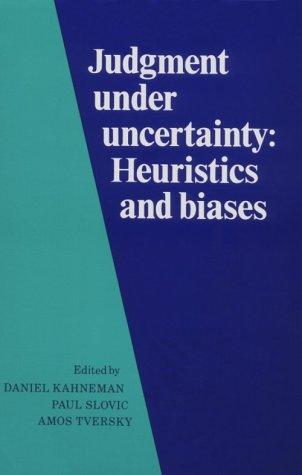
Judgment Under Uncertainty: Heuristics and Biases by Daniel Kahneman, Paul Slovic, and Amos Tversky is a 1982 psychology book about judgment, cognitive bias, heuristics. People judge probability using heuristics rather than calculating base rates. Representativeness, availability, and anchoring are the three primary heuristics Tversky and Kahneman identify, each with characteristic failure modes.
Summary
Judgment Under Uncertainty is the academic anthology that launched a research program. Edited by Daniel Kahneman, Paul Slovic, and Amos Tversky, it collects the foundational papers of what became the heuristics-and-biases literature — the body of work showing that human judgment under uncertainty systematically departs from the normative models of probability and rationality that economists and decision theorists had assumed. The book contains thirty-five papers, many now canonical, including Tversky and Kahneman's original work on representativeness, availability, and anchoring and adjustment.
The program's core finding is simple to state and surprising in its breadth: people do not calculate probabilities. Instead, they use cognitive shortcuts — heuristics — that are generally useful but produce predictable, systematic errors. Representativeness leads people to judge probability by how well something fits a prototype, ignoring base rates. Availability leads people to judge frequency by how easily examples come to mind, producing miscalibrated risk assessments. Anchoring and adjustment leads people to give too much weight to an initial number even when it is arbitrary. Each heuristic has a logic — they work well in most everyday situations — but in the specific conditions of probabilistic reasoning, they fail reliably and in identifiable ways.
The book is a primary source, not a popularization. It is organized into sections: representativeness, calibration, prediction, attribution, and risky choice. The papers vary in technical difficulty, but most are accessible to readers with no statistical background if they are willing to work through the examples. For readers who know Kahneman's Thinking, Fast and Slow, this anthology provides the scientific substance behind that book's narrative. Many of the famous studies — the conjunction fallacy, the Linda problem, base rate neglect, overconfidence — appear here in their original experimental form.
The limitations are those of any thirty-year-old anthology. Some findings have been refined or partially challenged by subsequent research. The ecological validity question — whether biases found in laboratory tasks with college students generalize to real-world expert judgment — has been contested by Gerd Gigerenzen and others. Nonetheless, the research program represented here transformed economics, medicine, law, and public policy, and the core findings about heuristics and their failures have proven robust. This is an essential text for anyone who wants to understand where behavioral economics and modern decision science came from.
Talk to Judgment Under Uncertainty: Heuristics and Biases like its author wrote you back.
Get the ideas that fit your life — not generic summaries.
- Chat with the book
- Audiobook-style main ideas
- Adapts to your life and goals
- Helps you take action
Key takeaways
- 1.
People judge probability using heuristics rather than calculating base rates. Representativeness, availability, and anchoring are the three primary heuristics Tversky and Kahneman identify, each with characteristic failure modes.
- 2.
Representativeness heuristic: we judge the probability that something belongs to a category by how well it resembles the category prototype, often neglecting base rate information that should dominate the calculation.
- 3.
Availability heuristic: we estimate frequency and probability by the ease with which examples come to mind. Vivid, recent, or personally experienced events are overweighted; abstract, statistical, or distant events are underweighted.
- 4.
Anchoring and adjustment: when estimating an uncertain quantity, initial values — even arbitrary ones — anchor the estimate. Adjustment from the anchor is typically insufficient, producing estimates that cluster too close to the starting point.
- 5.
The conjunction fallacy: people rate a specific, detailed scenario as more probable than a less specific one that logically encompasses it, when the description fits a social stereotype. This is a direct violation of probability theory.
- 6.
Calibration research shows that people are systematically overconfident in their factual judgments. Asked to give 90% confidence intervals, subjects' actual accuracy falls well below 90%, across many domains.
- 7.
These biases are not confined to novices. Expert judgment in medicine, finance, and other high-stakes domains shows the same heuristic-driven errors, though the specific expressions differ across domains.
- 8.
The normative-descriptive gap — the difference between how probability should be assessed and how it actually is — has implications for any institution that depends on human judgment under uncertainty, including medicine, law, and policy.
Discussion questions
Use these on your own, with a book club, or as chat starters in Superbook. Book club version, ready to copy or print →
- 1.
Kahneman and Tversky's program is built on identifying gaps between normative probability reasoning and actual human judgment. Do you find the normative standard — classical probability theory — to be the right benchmark? What else might count as good judgment?
- 2.
The representativeness heuristic leads people to ignore base rates. Think of a judgment you regularly make in your professional or personal life. Which base rates do you have available but probably underuse?
- 3.
Availability bias means we overweight what comes easily to mind. What risks in your own domain do you think you systematically overweight or underweight because of their availability rather than their actual frequency?
- 4.
The anchoring effect works even with arbitrary anchors. When you are negotiating, setting a budget, or making an estimate, how often do you take the first number seriously as information it shouldn't be?
- 5.
The Linda problem — in which people rate Linda-the-bank-teller-and-feminist as more probable than Linda-the-bank-teller — is one of the most replicated effects in the literature. Does the explanation (representativeness overriding probability) feel right when you introspect, or does it feel like a trick question?
- 6.
Calibration research shows systematic overconfidence. In which domains of your life do you think your confidence most exceeds your accuracy? How would you know?
- 7.
Gerd Gigerenzen has argued that many so-called biases are actually adaptive responses to the environments humans evolved in, and that the laboratory tasks used to demonstrate them are ecologically unusual. How persuasive do you find this critique?
- 8.
The book is an academic anthology from 1982. How much has the heuristics-and-biases literature changed or been refined since then, and which of the original findings do you think have aged best?
- 9.
Kahneman later developed these ideas into the System 1 / System 2 framework. Is that later framing an improvement, or does it lose something from the original papers' more specific accounts of each heuristic?
- 10.
Many readers encounter this material through Thinking, Fast and Slow rather than the original papers. What is the difference between reading popularized science and primary sources, and does it matter for how you apply the ideas?
- 11.
The research program has been applied heavily in policy — behavioral economics, nudge units, default design. What are the limits of applying laboratory-derived heuristics research to real-world institutional design?
- 12.
If you accepted the full force of the heuristics-and-biases findings, how would you change the decision-making processes in your organization, household, or professional practice?
Themes
Frequently asked questions
-
Is Judgment Under Uncertainty accessible to non-academics?
Partly. Many of the core papers — particularly the Tversky and Kahneman chapters — are written to be understood with high school probability knowledge. Some of the later chapters are more technical. Readers who want the ideas without the methodology may find Kahneman's Thinking, Fast and Slow more accessible, though this anthology gives the original experimental evidence.
-
How does this book relate to Thinking, Fast and Slow?
Thinking, Fast and Slow is Kahneman's narrative account of the same research program written for a general audience. This anthology contains the original experimental papers on which that book is based. They are complementary: the anthology gives you the data, Thinking Fast and Slow gives you the story.
-
Are the biases described in this book real, or have they been challenged?
The core effects — availability, representativeness, anchoring, overconfidence — have replicated robustly across decades and cultures. The interpretation has been contested, particularly by Gerd Gigerenzen's ecological rationality program. Some specific studies have failed replication in the broader replication crisis. The research program is foundational but not without legitimate scientific debate.
-
Who should read Judgment Under Uncertainty?
Anyone who wants to understand where behavioral economics and decision science came from should read the core Tversky-Kahneman papers in this anthology. Particularly valuable for economists, doctors, lawyers, and policy professionals whose work depends on human judgment under uncertainty.
-
What is the most practically important finding in the book?
Overconfidence in calibration. Across virtually every domain studied, people's confidence intervals are too narrow — they think they know more precisely than they do. This has direct implications for risk management, medical diagnosis, investment, and any domain where uncertainty estimation matters.
Similar books
Thinking, Fast and Slow
Daniel Kahneman
Noise: A Flaw in Human Judgment
Daniel Kahneman, Olivier Sibony, and Cass R. Sunstein
Predictably Irrational
Dan Ariely
Thinking in Bets: Making Smarter Decisions When You Don't Have All the Facts
Annie Duke
