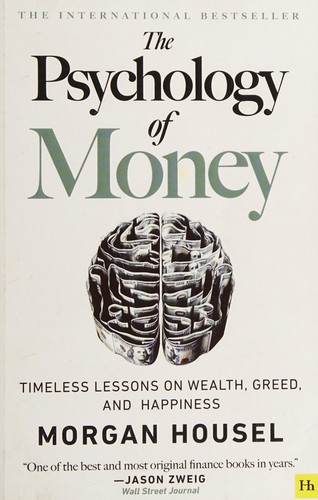
Talk to The Psychology of Money like its author wrote you back.
Get the ideas that fit your life — not generic summaries.
- Chat with the book
- Audiobook-style main ideas
- Adapts to your life and goals
- Helps you take action
What it argues
The Psychology of Money is Morgan Housel's argument that financial success depends less on technical knowledge than on behavior — specifically, on understanding how your personal history, emotions, and cognitive biases shape every financial decision you make. Housel is a former columnist for The Wall Street Journal and The Motley Fool, and the book collects his thinking on why smart people make poor financial decisions and why ordinary people with no financial training sometimes build remarkable wealth.
The book is structured as twenty short essays, each exploring a different psychological phenomenon in personal finance. The range is deliberately broad: why getting rich and staying rich require completely different skills, why luck and risk make financial outcomes less controllable than people believe, why saving is more about freedom than money, why being reasonable beats trying to be rational, why the highest form of financial wealth is having control over your time. The essays do not build a single systematic argument; they accumulate evidence for the thesis that behavior is the dominant factor in financial outcomes.
What it gets right
- 1.
Doing well with money has more to do with behavior than intelligence. Your history and psychology shape every financial decision in ways that are hard to observe from the inside.
- 2.
Luck and risk are siblings. Financial outcomes are more random than most people admit, which makes both excessive pride in success and excessive blame for failure unwarranted.
- 3.
Compounding requires time above all else. The math works, but only if you don't interrupt it by selling during downturns or switching strategies after bad years.
What it covers
Who wrote it
Morgan Housel is a partner at the Collaborative Fund and a former columnist at The Motley Fool and The Wall Street Journal. He has won multiple awards for financial journalism and is widely read as one of the clearest writers on investing and personal finance. The Psychology of Money, published in 2020, grew out of a blog post that became one of the most widely shared pieces of financial writing on the internet. Housel writes on the intersection of psychology, history, and money, and his essays are known for using historical anecdotes and counterintuitive observations to illuminate how and why people make the financial decisions they do. He is based in the Pacific Northwest.
