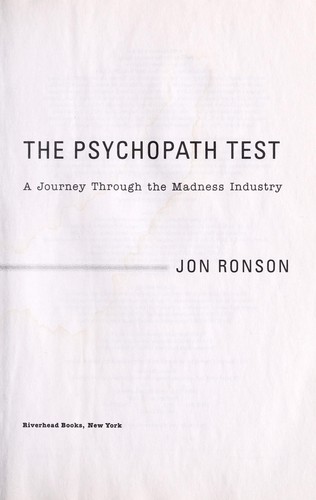
Talk to The Psychopath Test like its author wrote you back.
Get the ideas that fit your life — not generic summaries.
- Chat with the book
- Audiobook-style main ideas
- Adapts to your life and goals
- Helps you take action
What it argues
Jon Ronson is a journalist who starts investigating a strange series of anonymous books sent to academics around the world, and ends up spending a year exploring psychopathy, the Hare Psychopathy Checklist, and the question of whether the diagnostic categories psychiatry uses are tools for understanding people or labels that do damage of their own.
The book begins with Bob Hare, the Canadian psychologist who developed the twenty-item checklist that has become the standard instrument for diagnosing psychopathy. Ronson learns to use it, then starts applying it everywhere. He interviews Tony, a man who faked madness to avoid prison and cannot convince anyone he is now sane. He interviews Al Dunlap, the corporate raider who dismantled companies, fired thousands of workers, and now lives behind an electric fence with statues of predatory animals. He visits Broadmoor, a high-security psychiatric hospital, and meets men who are there indefinitely, not because they committed crimes but because they are considered dangerous.
What it gets right
- 1.
The Hare Psychopathy Checklist is the most widely used instrument for diagnosing psychopathy, but it was developed for specific forensic contexts and is now applied far beyond them.
- 2.
Many traits on the checklist — lack of empathy, superficial charm, failure to take responsibility — also describe successful executives and politicians, raising questions about what the checklist actually measures.
- 3.
Psychiatric labels, once applied, are very difficult to remove. Tony's case illustrates how the institutional logic of confinement can override individual evidence of change.
What it covers
Who wrote it
Jon Ronson is a British journalist and author known for immersive, often comic investigations of extreme belief and behavior. His books include Them: Adventures with Extremists, The Men Who Stare at Goats, and So You've Been Publicly Shamed. He has also written for film and television and is a frequent contributor to journalism on the stranger edges of institutions and belief. His style combines personal anxiety with genuine inquiry and a willingness to be wrong in public.
