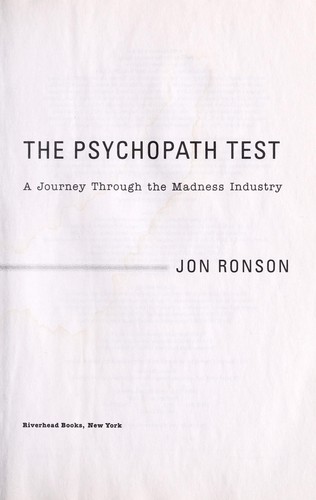
The Psychopath Test by Jon Ronson is a 2011 psychology book about psychopathy, psychiatry, diagnosis. The Hare Psychopathy Checklist is the most widely used instrument for diagnosing psychopathy, but it was developed for specific forensic contexts and is now applied far beyond them.
Summary
Jon Ronson is a journalist who starts investigating a strange series of anonymous books sent to academics around the world, and ends up spending a year exploring psychopathy, the Hare Psychopathy Checklist, and the question of whether the diagnostic categories psychiatry uses are tools for understanding people or labels that do damage of their own.
The book begins with Bob Hare, the Canadian psychologist who developed the twenty-item checklist that has become the standard instrument for diagnosing psychopathy. Ronson learns to use it, then starts applying it everywhere. He interviews Tony, a man who faked madness to avoid prison and cannot convince anyone he is now sane. He interviews Al Dunlap, the corporate raider who dismantled companies, fired thousands of workers, and now lives behind an electric fence with statues of predatory animals. He visits Broadmoor, a high-security psychiatric hospital, and meets men who are there indefinitely, not because they committed crimes but because they are considered dangerous.
Ronson's central question is diagnostic: how do we decide who is a psychopath, and what do we do with that designation? He is genuinely uncertain whether the construct is a useful scientific category or a way of marking certain people as beyond ordinary moral consideration. He is particularly interested in the presence of psychopathic traits in powerful people — CEOs, politicians — and in whether those traits are selected for by certain institutions.
The book wobbles between serious inquiry and comic set-pieces. Ronson's self-deprecating style sometimes undermines the weight of what he is describing. But it also models a kind of productive confusion — someone genuinely unsure what to believe, learning in public, and questioning whether the confidence of experts is warranted. The Psychopath Test is less a study of psychopathy than a study of how psychiatric labels travel through the world and what they do when they arrive.
Talk to The Psychopath Test like its author wrote you back.
Get the ideas that fit your life — not generic summaries.
- Chat with the book
- Audiobook-style main ideas
- Adapts to your life and goals
- Helps you take action
Key takeaways
- 1.
The Hare Psychopathy Checklist is the most widely used instrument for diagnosing psychopathy, but it was developed for specific forensic contexts and is now applied far beyond them.
- 2.
Many traits on the checklist — lack of empathy, superficial charm, failure to take responsibility — also describe successful executives and politicians, raising questions about what the checklist actually measures.
- 3.
Psychiatric labels, once applied, are very difficult to remove. Tony's case illustrates how the institutional logic of confinement can override individual evidence of change.
- 4.
The DSM has expanded dramatically, and critics argue that pathologizing common human experiences can cause harm — by stigmatizing ordinary variation and over-medicating children.
- 5.
Ronson argues that journalists are drawn to extreme cases and extreme diagnoses, which distorts public understanding of mental illness by making rare conditions seem common.
- 6.
The line between mental illness and moral failure is contested and culturally variable. Psychopathy is unusual in psychiatry because it is associated with deliberate harm rather than suffering.
- 7.
Power selects for certain traits. The corporate structures that reward short-term results, indifference to harm, and confident risk-taking may favor people who score highly on psychopathy measures.
- 8.
Certainty in diagnosis is often unjustified. Ronson's encounter with experts who are confident in opposite directions about the same individual suggests that psychological assessment is less reliable than it is treated as.
Discussion questions
Use these on your own, with a book club, or as chat starters in Superbook. Book club version, ready to copy or print →
- 1.
After reading the book, do you think psychopathy is a useful scientific category, a moral judgment dressed in clinical language, or something in between?
- 2.
Ronson describes applying the Hare Checklist to various people he meets. Did you find yourself applying it to anyone while reading? What does that impulse suggest?
- 3.
Tony's case raises the question of whether psychiatric hospitals ever get it wrong. How should institutions handle uncertainty about whether someone is genuinely changed?
- 4.
Al Dunlap's interview is one of the book's centerpieces. What did you make of the meeting between Ronson and someone who fits many of the checklist criteria but denies their significance?
- 5.
The book suggests that media coverage of mental illness tends to focus on extreme cases. How has that shaped your own understanding of conditions like psychopathy?
- 6.
Do you think there is a meaningful difference between someone who is a psychopath and someone who simply chooses to behave in psychopathic ways?
- 7.
Ronson is skeptical of the expansion of psychiatric diagnoses. Do you share that skepticism, or do you think broader diagnosis helps people get treatment they need?
- 8.
What is the relationship between psychopathic traits and success in certain careers? If those traits help people rise, what does that say about the environments that select for them?
- 9.
The book ends with Ronson feeling that he may have done harm through his investigations. What is the journalist's responsibility when covering mental illness?
- 10.
How much of what you call someone's personality versus their pathology is a matter of framing, context, or cultural convention?
- 11.
If you could apply the Hare Checklist to any institution — a corporation, a political party, a media outlet — what would you want to know about the results?
Themes
Frequently asked questions
-
Is The Psychopath Test a serious book or a comedy?
Both, and the combination is deliberate. Ronson's comic persona lets him approach subjects — criminal psychiatry, corporate cruelty — that might otherwise be too dark or too specialized. The serious questions about diagnosis and power are real even when the tone is light.
-
What is the Hare Psychopathy Checklist?
A 20-item diagnostic tool developed by Robert Hare to assess psychopathic personality traits. Items include pathological lying, lack of remorse, shallow affect, and parasitic lifestyle. It is scored by trained clinicians and is most valid in forensic contexts.
-
Does the book conclude that psychopathy is real?
Ronson leaves the question genuinely open. He takes the construct seriously enough to investigate it but ends skeptical about whether current instruments reliably identify it, and concerned about what happens to people once the label attaches.
-
Should I read this book if I have a personal connection to mental illness?
With some care. The book treats psychiatric diagnosis as a subject for investigation and skepticism, which some readers find valuable and others find dismissive. It is not primarily about living with mental illness but about how the system diagnoses and contains it.
-
What is the most unsettling idea in the book?
Probably that the traits associated with psychopathy may be selected for in certain powerful positions, and that society may be structured in ways that reward exactly the traits the checklist identifies as dangerous.
Similar books
The Lucifer Effect: Understanding How Good People Turn Evil
Philip Zimbardo
Subliminal: How Your Unconscious Mind Rules Your Behavior
Leonard Mlodinow
Mistakes Were Made (But Not by Me)
Carol Tavris and Elliot Aronson
The Elephant in the Brain: Hidden Motives in Everyday Life
Kevin Simler and Robin Hanson
