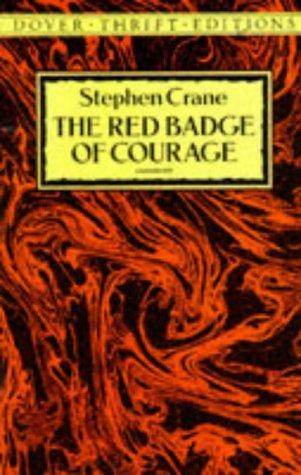
Talk to The Red Badge of Courage like its author wrote you back.
Get the ideas that fit your life — not generic summaries.
- Chat with the book
- Audiobook-style main ideas
- Adapts to your life and goals
- Helps you take action
The Red Badge of Courage, in detail
The Red Badge of Courage is a Civil War novel written by a man who had never been to war, published when Stephen Crane was twenty-four. It follows Henry Fleming, a young Union soldier who enlists with romantic notions of heroism and spends most of the novel either fleeing from battle, lying about his cowardice, or constructing elaborate rationalizations for his own behavior. What Crane achieved — a psychologically precise portrait of how fear and self-deception function in combat — was so accurate that veterans described reading it as a recovered memory.
The novel's real subject is the gap between war as myth and war as experience. Henry arrives expecting the Homeric battlefield — the individual test, the moment of discovered courage — and what he gets instead is chaos, noise, smoke, confusion, and the completely indifferent deaths of people around him. Crane is interested in the way ideology (about heroism, about manhood, about national purpose) shapes perception so thoroughly that reality has difficulty getting through. Henry doesn't simply misunderstand war before the battle; he keeps misunderstanding it after, constructing self-serving interpretations of his own behavior with impressive flexibility.
Crane's style is one of the novel's great achievements. He uses impressionistic, almost cinematic shifts in perspective — pulling back to describe the overall battle in grand, almost geological terms, then plunging into Henry's immediate sensory experience of mud and noise and fear. The prose is angular and modern in a way that felt alien to readers in 1895 and feels exactly right today. He also uses irony with great precision: the famous "red badge" that Henry eventually acquires is not a wound earned in battle but a blow from a fleeing Union soldier, and Crane never explains this to Henry or to us explicitly.
Readers who approach this as a conventional war narrative about the discovery of courage will be confused by the ending. Henry's final assessment of himself is not fully supported by the events we've observed; Crane seems to be demonstrating rather than explaining Henry's continued capacity for self-flattery. At under 150 pages, the novel is one of the most efficient uses of that length in American fiction — there is nothing here that doesn't earn its presence.
The big ideas
- 1.
Crane's central insight is that heroism and cowardice often look identical from outside — the distinction is internal, and even the internal distinction is subject to relentless self-interested revision.
- 2.
Henry's capacity for self-deception is the novel's consistent subject: each action he takes is rapidly reinterpreted as something more flattering than it actually was, and this process never fully stops.
- 3.
The 'red badge' itself — a wound acquired not in heroic combat but from a panicked comrade — is the novel's sharpest irony: Henry's symbol of courage is the mark of a different kind of cowardice.
