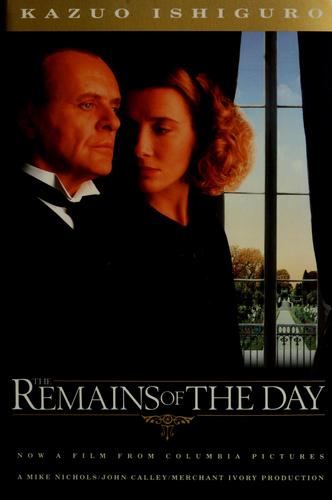
Talk to The Remains of the Day like its author wrote you back.
Get the ideas that fit your life — not generic summaries.
- Chat with the book
- Audiobook-style main ideas
- Adapts to your life and goals
- Helps you take action
What it argues
Kazuo Ishiguro's 1989 Booker Prize-winning novel is narrated by Stevens, an aging English butler who has devoted his life to Darlington Hall — and to his employer, Lord Darlington, who turned out to have fascist sympathies in the 1930s. The novel takes the form of Stevens's account of a motoring holiday through the English countryside in 1956, in which he visits Miss Kenton, the former housekeeper with whom he worked for two decades and with whom he may — he is not sure — have been in love.
The novel's central formal achievement is that Stevens is one of the great unreliable narrators in modern fiction, but his unreliability is not evasion or lying — it's a genuine inability to access his own emotional life. He has constructed himself as an instrument of professional service, and the self that could have loved Miss Kenton, or acknowledged complicity in Lord Darlington's politics, has been so thoroughly suppressed that he cannot quite reach it even in retrospect. The gaps between what Stevens says and what the novel's events make clear are the spaces where the real story lives.
What it gets right
- 1.
Stevens narrates his own story in a way that consistently obscures its most important emotional content — the gap between his account and what actually happened is the novel's central drama.
- 2.
The ideology of 'professional dignity' is shown to be both genuinely admirable and a mechanism for avoiding responsibility — Stevens used his vocation to avoid his life.
- 3.
Lord Darlington's trajectory from decent man to Nazi sympathizer is a case study in how good intentions and class deference can produce moral catastrophe.
What it covers
Who wrote it
Kazuo Ishiguro was born in Nagasaki, Japan, in 1954 and moved to England at age five. He studied creative writing at the University of East Anglia and published his first novel, A Pale View of Hills, in 1982. The Remains of the Day (1989) won the Booker Prize and established him as one of the major voices in contemporary British fiction. His subsequent novels include The Unconsoled (1995), When We Were Orphans (2000), and Never Let Me Go (2005). He was awarded the Nobel Prize in Literature in 2017.
