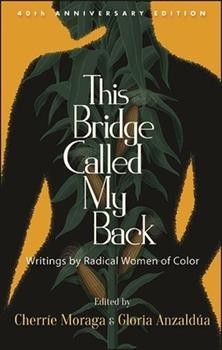
Talk to This Bridge Called My Back: Writings by Radical Women of Color like its author wrote you back.
Get the ideas that fit your life — not generic summaries.
- Chat with the book
- Audiobook-style main ideas
- Adapts to your life and goals
- Helps you take action
This Bridge Called My Back: Writings by Radical Women of Color, in detail
This Bridge Called My Back, first published in 1981 and edited by Cherríe Moraga and Gloria Anzaldúa, is a landmark anthology of writing by women of color in the United States. It collects essays, poems, letters, and personal testimonies from Black, Latina, Asian American, and Indigenous women who felt excluded from both mainstream feminist movements and movements organized around race alone. The book argues, in the editors' framing, that these women had to be bridges — spanning the gaps between struggles — and that this position was as exhausting as it was necessary.
The anthology's central argument is that identity cannot be neatly divided. The contributors write from experiences in which race, gender, class, and sexuality are inseparable. Audre Lorde's influence is palpable throughout, though the collection gives voice to writers less widely known at the time, including Barbara Smith, Cheryl Clarke, and Mitsuye Yamada. The book predates the term "intersectionality" — coined by Kimberlé Crenshaw in 1989 — but it describes the phenomenon with unusual precision and emotional force. The contributors are not interested in ranking their oppressions; they are interested in naming them all, and in the connections between them.
What distinguishes Bridge from academic texts on similar subjects is the intimacy of its form. Many pieces are written in the first person, addressed to other women of color, or to white feminists who had overlooked or appropriated their work. The anger is directed, not diffuse. Anzaldúa's introduction and her reflections on "the new mestiza consciousness" are among the most frequently cited passages in feminist and postcolonial studies, but the collection's power comes from its cumulative effect — the sheer number of voices insisting that their full selves matter.
The book has never been without controversy. Some critics find it too rooted in identity politics, too quick to place experience over argument. Its admirers, and they are many, point out that this objection misses the epistemological claim: for these writers, lived experience is evidence, and the failure to credit it is itself political. Four decades after its first publication, Bridge remains in print and on syllabi because the tensions it maps have not been resolved.
The big ideas
- 1.
Women of color occupy multiple, simultaneous identities — racial, gendered, classed — that cannot be analyzed one at a time without distorting their experience.
- 2.
Mainstream feminism in the 1970s often reproduced the racial hierarchies it claimed to challenge, centering white women's concerns at the expense of the coalition.
- 3.
The 'bridge' metaphor captures both the value and the exhaustion of mediating between movements: always translating, rarely fully claimed by either side.
