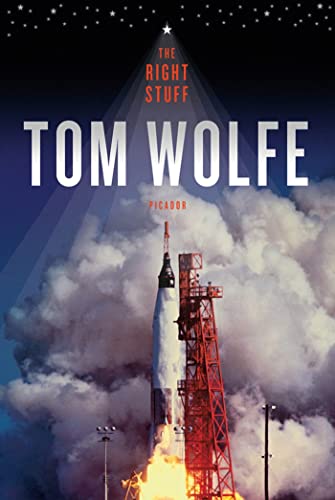
Talk to The Right Stuff like its author wrote you back.
Get the ideas that fit your life — not generic summaries.
- Chat with the book
- Audiobook-style main ideas
- Adapts to your life and goals
- Helps you take action
What it argues
Tom Wolfe's account of the early years of American manned spaceflight — from the test pilots of Edwards Air Force Base to the Mercury Seven astronauts — is the most celebrated work of New Journalism and one of the essential books about American culture in the twentieth century. Wolfe spent years reporting it, conducting interviews with pilots, astronauts, and their families, and the result is simultaneously a rigorous history of a technological program and a searching examination of the psychological culture it required.
The book begins not with NASA but with Edwards Air Force Base in the California desert, where test pilots were doing the most dangerous flying in the world in the late 1940s and 1950s. Wolfe introduces the concept of "the right stuff" — an ineffable quality of courage, skill, and cool-handedness that separated the men who survived from the men who didn't, and that the pilots themselves could not name without naming something they might not have. Chuck Yeager, who broke the sound barrier in 1947 and never became an astronaut, is the book's moral center — the embodiment of the right stuff who was eclipsed by the very program his achievement made possible.
What it gets right
- 1.
The 'right stuff' is an explicitly unspeakable quality — naming it would break the code that made it work. Wolfe builds the entire book around the difficulty of defining what he is describing.
- 2.
Mythology and reality coexist uneasily in the Mercury program. The astronauts were brave men doing dangerous things who were also managed as public symbols in ways that distorted what they were actually doing.
- 3.
Chuck Yeager represents the pre-astronaut ideal — the test pilot's ethos — that the space program superseded without honoring. His absence from the astronaut corps is not accidental; he lacked the right academic credentials.
What it covers
Who wrote it
Tom Wolfe (1930–2018) was the American journalist and novelist who, along with Gay Talese, Hunter S. Thompson, and Joan Didion, invented New Journalism in the 1960s and 1970s. His books of journalism include The Electric Kool-Aid Acid Test, Radical Chic, and The Painted Word, and his novels The Bonfire of the Vanities and A Man in Full were major literary events. The Right Stuff, published in 1979, is widely considered his masterpiece. He taught at the Columbia School of Journalism and received the National Book Award for his first novel.
