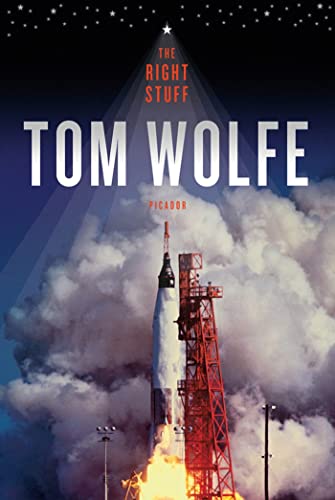
The Right Stuff by Tom Wolfe is a 1979 memoir book about courage, competition, american mythology. The 'right stuff' is an explicitly unspeakable quality — naming it would break the code that made it work. Wolfe builds the entire book around the difficulty of defining what he is describing.
Summary
Tom Wolfe's account of the early years of American manned spaceflight — from the test pilots of Edwards Air Force Base to the Mercury Seven astronauts — is the most celebrated work of New Journalism and one of the essential books about American culture in the twentieth century. Wolfe spent years reporting it, conducting interviews with pilots, astronauts, and their families, and the result is simultaneously a rigorous history of a technological program and a searching examination of the psychological culture it required.
The book begins not with NASA but with Edwards Air Force Base in the California desert, where test pilots were doing the most dangerous flying in the world in the late 1940s and 1950s. Wolfe introduces the concept of "the right stuff" — an ineffable quality of courage, skill, and cool-handedness that separated the men who survived from the men who didn't, and that the pilots themselves could not name without naming something they might not have. Chuck Yeager, who broke the sound barrier in 1947 and never became an astronaut, is the book's moral center — the embodiment of the right stuff who was eclipsed by the very program his achievement made possible.
The Mercury Seven — the astronauts selected for the first American space program — are rendered with precision and irony. Wolfe is respectful of their courage but equally interested in the gap between their actual role (they were essentially passengers in the early missions, controlled by NASA's automation) and their public portraiture as heroic pilots. The media management of the Mercury program — the exclusive Life magazine contracts, the carefully constructed family-man images — is treated as a form of mythology-making that both enabled the program's political success and distorted public understanding of what the astronauts were actually doing.
The Soviet competition runs through the book as counterpoint. Each American achievement is measured against a Soviet one; the terror that the Soviets were winning shaped the political pressures that drove the Mercury program to take risks that a purely scientific project would not have. Wolfe does not praise or condemn this dynamic; he traces it with the New Journalist's eye for the cultural forces that drive behavior.
Talk to The Right Stuff like its author wrote you back.
Get the ideas that fit your life — not generic summaries.
- Chat with the book
- Audiobook-style main ideas
- Adapts to your life and goals
- Helps you take action
Key takeaways
- 1.
The 'right stuff' is an explicitly unspeakable quality — naming it would break the code that made it work. Wolfe builds the entire book around the difficulty of defining what he is describing.
- 2.
Mythology and reality coexist uneasily in the Mercury program. The astronauts were brave men doing dangerous things who were also managed as public symbols in ways that distorted what they were actually doing.
- 3.
Chuck Yeager represents the pre-astronaut ideal — the test pilot's ethos — that the space program superseded without honoring. His absence from the astronaut corps is not accidental; he lacked the right academic credentials.
- 4.
The Cold War shaped the space program as much as science did. NASA's timelines and risk tolerances were driven by political terror about Soviet superiority rather than by purely technical logic.
- 5.
New Journalism as method: Wolfe uses novelistic techniques — interior monologue, scene-by-scene construction, the rhythms of consciousness — to report events he did not witness. The method is inseparable from the argument.
- 6.
Fame and achievement diverge. The Mercury astronauts became national heroes; the test pilots who did equally dangerous and arguably more skilled work were largely unknown.
- 7.
The single-combat warrior metaphor: Wolfe argues that the astronauts functioned as modern equivalents of the individual warrior who fights on behalf of a tribe, and that their public role made psychological and anthropological sense.
- 8.
Institutional pressure to succeed produces its own distortions. The desire to beat the Soviets led NASA to manage information, suppress failure, and project confidence that the technical reality did not yet justify.
Discussion questions
Use these on your own, with a book club, or as chat starters in Superbook. Book club version, ready to copy or print →
- 1.
Wolfe never defines 'the right stuff' directly. Is that a strength of the book, or does the vagueness eventually frustrate you?
- 2.
Chuck Yeager is not an astronaut but is arguably the book's hero. What does his centrality say about Wolfe's values and the book's argument?
- 3.
The Mercury astronauts were not test pilots in the traditional sense — they were largely passengers in early missions. How does Wolfe handle the gap between their public image and their actual role?
- 4.
Wolfe's New Journalism technique involves inventing interior states and dialogue he could not have known. Does that bother you? What does it add?
- 5.
The wives of the astronauts and test pilots are portrayed as peripheral but under tremendous pressure. What does the book say about the gendered costs of the right stuff culture?
- 6.
Is the 'right stuff' admirable, pathological, or both? Does the book settle this question?
- 7.
The Space Race was driven largely by Cold War political competition rather than scientific necessity. Does that origin make the achievement less meaningful?
- 8.
Wolfe treats the media management of the Mercury program with irony. How much has NASA's relationship with the press changed since the 1960s?
- 9.
The book ends effectively before the moon landings. If Wolfe had continued, what would the Apollo program have added or changed?
- 10.
Which of the Mercury Seven does the book make most vivid? Does your answer tell you anything about Wolfe's sympathies?
- 11.
Is the 'right stuff' culturally specific — an American quality — or universal? Does the book argue for either position?
Themes
Frequently asked questions
-
Is The Right Stuff accurate?
The essential facts are accurate and well-sourced from extensive interviews. Wolfe's New Journalism technique involves interior monologue and reconstructed dialogue that he could not have directly observed — a practice he disclosed and defended. Most of the astronauts and pilots who commented on the book found it roughly accurate in spirit if not in every particular.
-
Do I need to know about spaceflight to enjoy it?
No. The technical details are accessible and not the point. Wolfe is more interested in psychology, culture, and mythology than in engineering. Readers with no background in the space program find it just as gripping as aviation enthusiasts.
-
How does the book relate to the 1983 film?
Philip Kaufman's film adaptation is excellent but necessarily compresses and simplifies. Wolfe's treatment of the test pilot culture and Yeager's role is richer in the book; the film focuses more on the Mercury Seven astronauts.
-
Why is Chuck Yeager so central if he was never an astronaut?
Wolfe uses Yeager as the standard against which the astronauts are measured. In his reading, Yeager represents the pure, unmediated version of the right stuff — courage without institutional processing — that the astronauts possessed but were prevented from expressing by NASA's management.
-
Is The Right Stuff a work of journalism or literature?
Wolfe argued it was both, and that the distinction was false. It is reported, factual, and thoroughly researched, and it is also written with novelistic technique, moral intelligence, and formal ambition. Most readers and critics consider it one of the finest pieces of American nonfiction regardless of category.