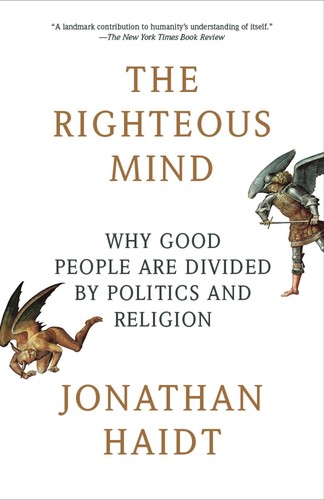
Talk to The Righteous Mind: Why Good People Are Divided by Politics and Religion like its author wrote you back.
Get the ideas that fit your life — not generic summaries.
- Chat with the book
- Audiobook-style main ideas
- Adapts to your life and goals
- Helps you take action
What it argues
The Righteous Mind is Jonathan Haidt's argument that moral reasoning is not the source of our moral judgments — it's the press secretary for them. Haidt draws on years of social psychology research to show that people reach moral conclusions instantly and emotionally, then construct rational-sounding justifications afterward. The metaphor he uses throughout: the mind is a rider on an elephant. The elephant (intuition) goes where it wants; the rider (reason) mostly invents explanations for where they ended up.
From this foundation, Haidt builds an account of why people with different moral foundations genuinely cannot understand each other. He introduces Moral Foundations Theory, which identifies six psychological systems that all humans share in varying degrees: Care/harm, Fairness/cheating, Loyalty/betrayal, Authority/subversion, Sanctity/degradation, and Liberty/oppression. His research shows that political liberals tend to rely heavily on Care and Fairness while largely ignoring the other four. Conservatives activate all six. This isn't a story of one side being more moral — it's a story of different moral grammars producing sincere disagreements that look, from the outside, like stupidity or malice.
What it gets right
- 1.
Moral intuitions come first, strategic reasoning second. People reach moral verdicts quickly and emotionally, then construct post-hoc justifications — Haidt calls this the social intuitionist model.
- 2.
The rider-and-elephant metaphor captures the relationship: the elephant (intuition) moves where it wants, and the rider (reason) mostly confabulates explanations for the direction.
- 3.
Moral Foundations Theory identifies six psychological systems: Care/harm, Fairness/cheating, Loyalty/betrayal, Authority/subversion, Sanctity/degradation, and Liberty/oppression.
What it covers
Who wrote it
Jonathan Haidt is a social psychologist and professor at New York University's Stern School of Business. He is the author of The Happiness Hypothesis, The Coddling of the American Mind (with Greg Lukianoff), and The Anxious Generation. His research on moral psychology and political psychology helped establish Moral Foundations Theory. He co-founded Heterodox Academy, an organization dedicated to viewpoint diversity in higher education. His 2012 TED Talk on the moral roots of liberals and conservatives remains one of the most-watched talks on political psychology.
