The Righteous Mind: Why Good People Are Divided by Politics and Religion by Jonathan Haidt is a 2012 psychology book about moral psychology, political polarization, intuition. Moral intuitions come first, strategic reasoning second. People reach moral verdicts quickly and emotionally, then construct post-hoc justifications — Haidt calls this the social intuitionist model.
Summary
The Righteous Mind is Jonathan Haidt's argument that moral reasoning is not the source of our moral judgments — it's the press secretary for them. Haidt draws on years of social psychology research to show that people reach moral conclusions instantly and emotionally, then construct rational-sounding justifications afterward. The metaphor he uses throughout: the mind is a rider on an elephant. The elephant (intuition) goes where it wants; the rider (reason) mostly invents explanations for where they ended up.
From this foundation, Haidt builds an account of why people with different moral foundations genuinely cannot understand each other. He introduces Moral Foundations Theory, which identifies six psychological systems that all humans share in varying degrees: Care/harm, Fairness/cheating, Loyalty/betrayal, Authority/subversion, Sanctity/degradation, and Liberty/oppression. His research shows that political liberals tend to rely heavily on Care and Fairness while largely ignoring the other four. Conservatives activate all six. This isn't a story of one side being more moral — it's a story of different moral grammars producing sincere disagreements that look, from the outside, like stupidity or malice.
The third part of the book addresses religion and the psychology of group cohesion. Haidt argues that religion did not evolve primarily to explain the world or comfort individuals but to bind communities together around shared moral frameworks. Drawing on Durkheim rather than Dawkins, he treats religiosity as a functional adaptation: groups with strong ritual, shared identity, and in-group loyalty outcompeted groups without it. This reframe extends to secular ideologies and political tribes, which perform the same binding function.
Haidt is careful to note the costs of his model. If moral intuitions run ahead of reason, and if our reasoning mostly serves to justify what we already feel, then productive political conversation is rare and accidental. The book is more diagnostic than prescriptive — it explains why the culture wars are so durable without offering a clean way out. What it does offer is a more honest picture of how moral minds actually work, which is the necessary starting point for anyone trying to think clearly about disagreement.
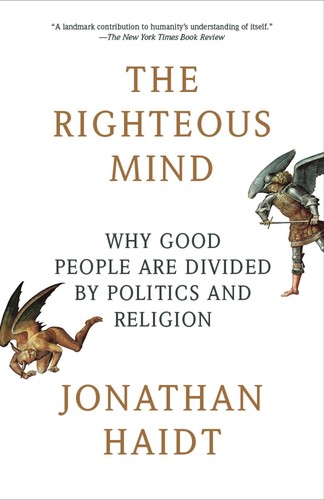
Talk to The Righteous Mind: Why Good People Are Divided by Politics and Religion like its author wrote you back.
Get the ideas that fit your life — not generic summaries.
- Chat with the book
- Audiobook-style main ideas
- Adapts to your life and goals
- Helps you take action
Key takeaways
- 1.
Moral intuitions come first, strategic reasoning second. People reach moral verdicts quickly and emotionally, then construct post-hoc justifications — Haidt calls this the social intuitionist model.
- 2.
The rider-and-elephant metaphor captures the relationship: the elephant (intuition) moves where it wants, and the rider (reason) mostly confabulates explanations for the direction.
- 3.
Moral Foundations Theory identifies six psychological systems: Care/harm, Fairness/cheating, Loyalty/betrayal, Authority/subversion, Sanctity/degradation, and Liberty/oppression.
- 4.
Liberals tend to build moral worldviews primarily around Care and Fairness. Conservatives draw on all six foundations more evenly. This difference in moral grammar explains a large portion of political conflict.
- 5.
Moral reasoning rarely changes minds in real-time argument. Haidt's studies show people stick to their gut verdict even when they can't articulate a reason — what he calls 'moral dumbfounding.'
- 6.
Religion's primary function is not metaphysical but social: it binds groups together through ritual, shared identity, and collective obligations. Secular ideologies serve the same function.
- 7.
Human nature is 90 percent chimp and 10 percent bee. We are mostly selfish but capable of genuine self-transcendence when embedded in a group united by shared purpose.
- 8.
Political opponents are not irrational or evil — they are people with different moral foundations activated at different intensities. Understanding this does not require agreeing with them.
- 9.
Cross-cutting relationships — friendships and working relationships that cut across tribal lines — are one of the few reliable mechanisms for moderating moral judgment.
Discussion questions
Use these on your own, with a book club, or as chat starters in Superbook. Book club version, ready to copy or print →
- 1.
Haidt claims that moral reasoning usually follows moral intuition rather than leading it. Can you think of a time when careful reasoning actually changed your moral view, rather than just reinforcing it?
- 2.
Which of the six moral foundations — Care, Fairness, Loyalty, Authority, Sanctity, Liberty — do you find most compelling? Which feels least like a genuine moral concern to you, and why?
- 3.
If your political views are primarily grounded in two or three foundations, what would it take to genuinely hear the moral concerns of someone drawing on different ones?
- 4.
Haidt describes 'moral dumbfounding' — the experience of holding a strong moral conviction you cannot rationally justify. What examples come to mind from your own moral beliefs?
- 5.
The rider-and-elephant model implies that most of what we call moral argument is rationalization after the fact. Does that feel accurate in your own experience? What are the implications for how we argue?
- 6.
Haidt argues that religion evolved to bind communities, not to explain the world. Does that functional account change how you think about religious practice — your own or others'?
- 7.
Do you think political polarization in your country reflects genuine moral disagreement, or something else — like media incentives, economic anxiety, or identity performance?
- 8.
Haidt suggests that exposing yourself to the best version of the other side's moral argument is more useful than arguing with its worst version. What is the strongest version of a moral position you usually oppose?
- 9.
The book argues that group selection shaped human psychology for tribalism. Does knowing this make tribalism feel more forgivable, or does it make it more urgent to counteract?
- 10.
Haidt is more diagnostic than prescriptive. After reading his account, do you feel more or less hopeful about productive disagreement across political lines? What changed?
- 11.
Cross-cutting relationships — friendships with people who hold opposing moral frameworks — are described as one of the few reliable moderating forces. How many of those do you actually have?
- 12.
Haidt's model suggests that moral outrage often functions as in-group signaling rather than genuine ethical engagement. Can you think of a recent example — public or personal — that fits that pattern?
Themes
Frequently asked questions
-
What is The Righteous Mind about?
It's a social psychology book arguing that moral judgments are driven by intuition, not reasoning, and that political and religious disagreements are largely the result of people operating with different moral foundations — not different facts or different intelligence.
-
Is The Righteous Mind worth reading?
Yes, particularly if you find yourself baffled or frustrated by how people you consider intelligent can hold moral views you find obviously wrong. Haidt's model doesn't resolve that frustration, but it makes it more comprehensible. The writing is clear and the research is explained accessibly.
-
What is Moral Foundations Theory?
A framework Haidt developed with colleagues identifying six psychological systems that underlie human moral reasoning: Care/harm, Fairness/cheating, Loyalty/betrayal, Authority/subversion, Sanctity/degradation, and Liberty/oppression. Different cultures and political groups weight these differently.
-
Who should read The Righteous Mind?
Anyone trying to understand political polarization, cross-cultural moral disagreement, or why religious communities think the way they do. It's especially useful for people who work across political or cultural lines and want a more accurate model of what's actually happening in moral disagreements.
-
Does the book offer solutions to political polarization?
Not really. Haidt is more interested in diagnosis than prescription. He notes that cross-cutting relationships — genuine friendships across tribal lines — help moderate moral judgment, but the book doesn't offer a policy agenda or a self-help program. Its value is understanding, not a fix.
Similar books
Thinking, Fast and Slow
Daniel Kahneman
Behave: The Biology of Humans at Our Best and Worst
Robert M. Sapolsky
Sapiens: A Brief History of Humankind
Yuval Noah Harari
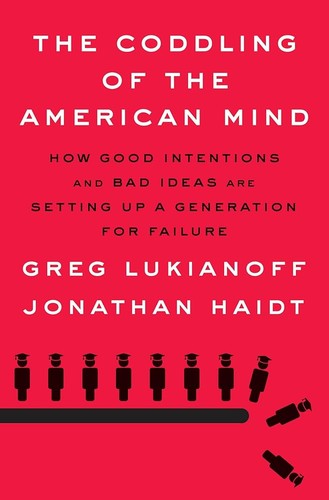
The Coddling of the American Mind
Greg Lukianoff and Jonathan Haidt
