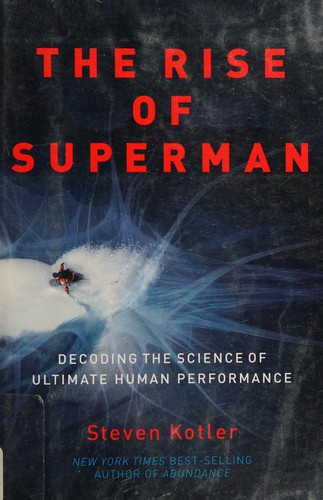
Talk to The Rise of Superman like its author wrote you back.
Get the ideas that fit your life — not generic summaries.
- Chat with the book
- Audiobook-style main ideas
- Adapts to your life and goals
- Helps you take action
What it argues
The Rise of Superman uses action sports as a lens for examining flow states — the psychological condition of total absorption, effortless action, and peak performance first described systematically by Mihaly Csikszentmihalyi. Steven Kotler argues that extreme athletes have been the most effective practitioners of flow in recent decades, and that the dramatic progression of human performance limits in surfing, skiing, snowboarding, skateboarding, and BASE jumping over the past thirty years is partially explained by competitors' ability to access flow reliably and consistently.
Kotler draws on interviews with dozens of elite action sport athletes and maps their experiences onto the neuroscience of flow: the massive release of norepinephrine, dopamine, serotonin, endorphins, and anandamide that characterizes deep flow states, and the transient hypofrontality (suppression of the prefrontal cortex) that eliminates self-consciousness and produces the sense of time dilation and effortless performance. He argues that action sports created ideal conditions for flow because the consequences of failure are severe enough to force total presence — there is no mental capacity left for distraction when a mistake means death.
What it gets right
- 1.
Flow is a neurochemical state characterized by the simultaneous release of norepinephrine, dopamine, serotonin, endorphins, and anandamide. It produces heightened performance, time distortion, and effortless action.
- 2.
Extreme sports created unusually effective conditions for flow because severe consequences of failure demand total presence. The mind cannot wander when survival is at stake.
- 3.
The most important flow trigger is a challenge-to-skill ratio at the edge of ability — hard enough to demand full engagement, not so hard that panic replaces focus.
What it covers
Who wrote it
Steven Kotler is an American journalist, author, and cofounder of the Flow Research Collective, an organization that studies peak performance and the science of flow. He has written extensively on human potential, neuroscience, and technology for publications including the New York Times, Atlantic, and Forbes. His other books include Abundance, Bold, The Art of Impossible, and Stealing Fire, which he coauthored with Jamie Wheal and which explores altered states in performance contexts. Kotler lives in New Mexico, where he trains sled dogs and continues his research.
