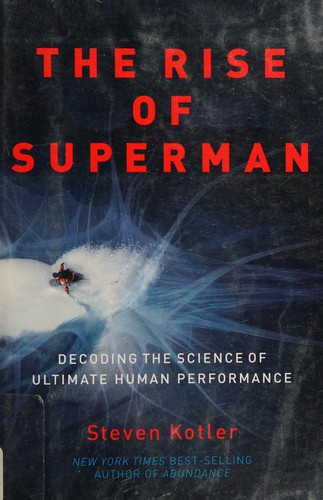
The Rise of Superman by Steven Kotler is a 2014 health book about flow state, peak performance, extreme sports. Flow is a neurochemical state characterized by the simultaneous release of norepinephrine, dopamine, serotonin, endorphins, and anandamide. It produces heightened performance, time distortion, and effortless action.
Summary
The Rise of Superman uses action sports as a lens for examining flow states — the psychological condition of total absorption, effortless action, and peak performance first described systematically by Mihaly Csikszentmihalyi. Steven Kotler argues that extreme athletes have been the most effective practitioners of flow in recent decades, and that the dramatic progression of human performance limits in surfing, skiing, snowboarding, skateboarding, and BASE jumping over the past thirty years is partially explained by competitors' ability to access flow reliably and consistently.
Kotler draws on interviews with dozens of elite action sport athletes and maps their experiences onto the neuroscience of flow: the massive release of norepinephrine, dopamine, serotonin, endorphins, and anandamide that characterizes deep flow states, and the transient hypofrontality (suppression of the prefrontal cortex) that eliminates self-consciousness and produces the sense of time dilation and effortless performance. He argues that action sports created ideal conditions for flow because the consequences of failure are severe enough to force total presence — there is no mental capacity left for distraction when a mistake means death.
The second half of the book extends the argument beyond extreme sports. Kotler identifies the flow triggers — high challenge-to-skill ratio, clear goals, immediate feedback, deep embodiment, and risk — and examines how they can be cultivated in less life-threatening contexts. He makes a case that flow is learnable and that its cultivation is one of the most important skills a person can develop, both for performance and for what he describes as the intrinsic experience of being alive.
The book works best as a collection of extraordinary athletic narratives. The science is real but thin in places — flow research is genuine and growing, but Kotler's certainty about the mechanisms sometimes exceeds the evidence. Readers looking for a practical how-to guide may be frustrated; the prescriptions are motivating but less concrete than the athletic stories that inspired them. As an introduction to flow concepts and a compelling argument for why they matter, it is effective.
Talk to The Rise of Superman like its author wrote you back.
Get the ideas that fit your life — not generic summaries.
- Chat with the book
- Audiobook-style main ideas
- Adapts to your life and goals
- Helps you take action
Key takeaways
- 1.
Flow is a neurochemical state characterized by the simultaneous release of norepinephrine, dopamine, serotonin, endorphins, and anandamide. It produces heightened performance, time distortion, and effortless action.
- 2.
Extreme sports created unusually effective conditions for flow because severe consequences of failure demand total presence. The mind cannot wander when survival is at stake.
- 3.
The most important flow trigger is a challenge-to-skill ratio at the edge of ability — hard enough to demand full engagement, not so hard that panic replaces focus.
- 4.
Transient hypofrontality — temporary suppression of prefrontal cortex activity — removes the self-critical inner voice during flow. The absence of self-consciousness is partly why peak performance feels effortless.
- 5.
Flow accelerates skill acquisition. Learning under conditions of total engagement consolidates skills faster than routine, low-stakes practice.
- 6.
Action sports athletes have collectively pushed human performance limits far beyond what physiologists once considered possible. Kotler argues flow explains much of this acceleration.
- 7.
Clear goals and immediate feedback are essential flow triggers. Vague goals and delayed feedback prevent the state from engaging regardless of skill level.
- 8.
Flow is intrinsically motivating. The experience itself is so rewarding that people in flow-rich activities often structure their entire lives to access the state more frequently.
Discussion questions
Use these on your own, with a book club, or as chat starters in Superbook. Book club version, ready to copy or print →
- 1.
When have you experienced a state that resembles what Kotler describes as flow? What conditions produced it?
- 2.
Kotler argues that severe risk forces the total presence required for flow. What lower-stakes conditions in your own life have produced something similar?
- 3.
The athletes in the book regularly risk their lives for performance. Does the extreme risk make their experiences more or less instructive for people operating in safer domains?
- 4.
Kotler claims flow states have driven the most rapid performance progression in human history. Do you find that argument convincing, or are there simpler explanations for the progression in extreme sports?
- 5.
The challenge-to-skill ratio is the central flow trigger. In your most important work, are you currently operating at your edge or in a comfort zone?
- 6.
Transient hypofrontality means the inner critic goes quiet during flow. What would you attempt or create if that voice were reliably absent?
- 7.
Flow accelerates learning. What skill do you most want to develop, and are the conditions in which you practice it conducive to flow?
- 8.
The book describes athletes who organized their lives entirely around flow access. Would that kind of commitment appeal to you, or does it sacrifice too much?
- 9.
Kotler connects flow to intrinsic motivation. What activities in your life are you doing primarily for the intrinsic experience, not the outcome?
- 10.
The neuroscience of flow is real but still developing. How much does knowing the mechanism change the value of the experience itself?
- 11.
The athletes interviewed describe flow as the most alive they ever feel. What does feeling most alive look like for you?
- 12.
Kotler argues flow is learnable and should be cultivated deliberately. What in your current work or practice could you redesign to increase the likelihood of flow?
Themes
Frequently asked questions
-
What is The Rise of Superman about?
It uses the extraordinary progression of human performance in extreme sports over the past thirty years to argue that flow states — conditions of total absorption and peak neurochemical performance — explain much of what we consider superhuman achievement.
-
Is The Rise of Superman worth reading?
Yes, particularly for the athletic narratives and as an accessible introduction to flow science. Readers looking for a rigorous scientific treatment should also read Csikszentmihalyi's original work. The book is most engaging as a case study collection with a performance science frame.
-
How is The Rise of Superman different from Flow by Csikszentmihalyi?
Csikszentmihalyi's book is the foundational academic work on flow applied across many life domains. Kotler's book focuses specifically on extreme sports as a natural laboratory for flow, is more narrative-driven, and includes updated neuroscience research.
-
Who should read this book?
Athletes, performers, and knowledge workers interested in optimizing the conditions for peak performance. Also useful for anyone who wants a science-backed framework for thinking about intrinsic motivation and total engagement.
-
What is the most actionable idea in The Rise of Superman?
Audit your most important work for the four primary flow triggers: a challenge-to-skill ratio at your edge, clear goals, immediate feedback, and deep embodiment. Adjust one of them and observe whether it changes the quality of your engagement.
Similar books
Flow: The Psychology of Optimal Experience
Mihaly Csikszentmihalyi

Can't Hurt Me
David Goggins
Peak Performance
Brad Stulberg
Grit: The Power of Passion and Perseverance
Angela Duckworth
