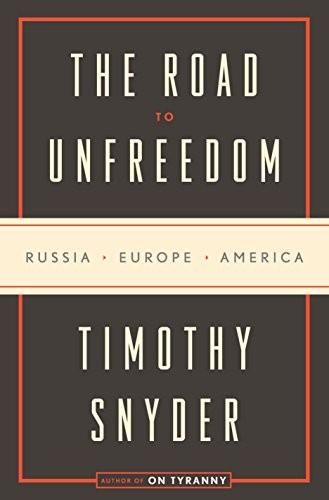
Talk to The Road to Unfreedom: Russia, Europe, America like its author wrote you back.
Get the ideas that fit your life — not generic summaries.
- Chat with the book
- Audiobook-style main ideas
- Adapts to your life and goals
- Helps you take action
What it argues
The Road to Unfreedom is Timothy Snyder's analysis of how Russia developed a new form of authoritarian politics under Vladimir Putin and began exporting it to Europe and the United States in the 2010s. The book is organized around a philosophical opposition between two views of time: the "politics of inevitability," which holds that history moves toward a predetermined good end (liberal democracy, market capitalism), and the "politics of eternity," which denies progress and offers instead a mythologized national past in which the nation is always the victim of foreign enemies. Snyder argues that the West was vulnerable to Russian influence partly because its own politics of inevitability had already been hollowing out its capacity for critical thought.
Snyder traces the intellectual roots of Putin's ideological project to Ivan Ilyin, a Russian fascist philosopher of the early twentieth century whose ideas were systematically revived and promoted by the Kremlin. Ilyin held that Russia was a unique civilization that could never be judged by Western liberal standards, and that it had a sacred mission to purify the world of decadence. This framework, Snyder argues, is not propaganda in the ordinary sense but a coherent and exportable ideology that has found audiences across Europe and in the American right.
What it gets right
- 1.
The 'politics of inevitability' — the assumption that history moves automatically toward liberal democracy — leaves societies unable to recognize or resist regression.
- 2.
The 'politics of eternity' offers no forward direction but a cyclical narrative in which the nation is perennially victimized by foreigners. It is mobilizing without being hopeful.
- 3.
Ivan Ilyin, a Russian fascist philosopher, provided intellectual scaffolding for Putin's ideology. The Kremlin systematically rehabilitated and distributed his ideas after 2000.
What it covers
Who wrote it
Timothy Snyder is the Richard C. Levin Professor of History at Yale University and a permanent fellow at the Institute for Human Sciences in Vienna. He is the author of more than ten books on Eastern European history and political thought, including Bloodlands, On Tyranny, and Black Earth. Snyder reads more than a dozen languages and has conducted research in archives across Eastern Europe. He is widely regarded as one of the leading historians of modern European state violence and totalitarianism.
