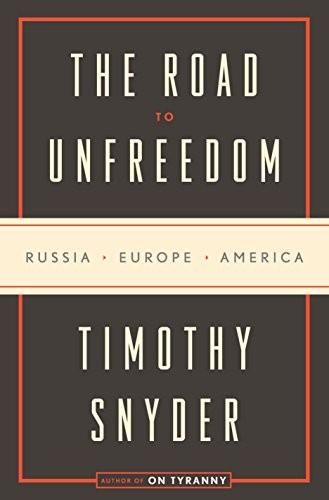
The Road to Unfreedom: Russia, Europe, America by Timothy Snyder is a 2018 history book about authoritarianism, propaganda, russian politics. The 'politics of inevitability' — the assumption that history moves automatically toward liberal democracy — leaves societies unable to recognize or resist regression.
Summary
The Road to Unfreedom is Timothy Snyder's analysis of how Russia developed a new form of authoritarian politics under Vladimir Putin and began exporting it to Europe and the United States in the 2010s. The book is organized around a philosophical opposition between two views of time: the "politics of inevitability," which holds that history moves toward a predetermined good end (liberal democracy, market capitalism), and the "politics of eternity," which denies progress and offers instead a mythologized national past in which the nation is always the victim of foreign enemies. Snyder argues that the West was vulnerable to Russian influence partly because its own politics of inevitability had already been hollowing out its capacity for critical thought.
Snyder traces the intellectual roots of Putin's ideological project to Ivan Ilyin, a Russian fascist philosopher of the early twentieth century whose ideas were systematically revived and promoted by the Kremlin. Ilyin held that Russia was a unique civilization that could never be judged by Western liberal standards, and that it had a sacred mission to purify the world of decadence. This framework, Snyder argues, is not propaganda in the ordinary sense but a coherent and exportable ideology that has found audiences across Europe and in the American right.
The bulk of the book is an account of Russian aggression in Ukraine from 2013 to 2016: the Maidan revolution, the annexation of Crimea, the war in the Donbas, the MH17 shootdown, and the Russian interference in the 2016 American election. Snyder analyzes Russian state media's techniques in detail — the weaponization of ambiguity, the saturation of the information space with contradictory narratives, the use of gay rights as a proxy for civilizational conflict — and shows how these techniques were adapted and deployed in Western political environments.
The Road to Unfreedom is more argumentative and more contemporary than Snyder's earlier work, and it has been criticized for overreaching in some of its claims about American politics. But as an analysis of how the politics of eternity operates, and how it exploits the weaknesses of societies that no longer know how to tell a coherent story about themselves, it is one of the more clarifying books written about the political environment of the mid-2010s.
Talk to The Road to Unfreedom: Russia, Europe, America like its author wrote you back.
Get the ideas that fit your life — not generic summaries.
- Chat with the book
- Audiobook-style main ideas
- Adapts to your life and goals
- Helps you take action
Key takeaways
- 1.
The 'politics of inevitability' — the assumption that history moves automatically toward liberal democracy — leaves societies unable to recognize or resist regression.
- 2.
The 'politics of eternity' offers no forward direction but a cyclical narrative in which the nation is perennially victimized by foreigners. It is mobilizing without being hopeful.
- 3.
Ivan Ilyin, a Russian fascist philosopher, provided intellectual scaffolding for Putin's ideology. The Kremlin systematically rehabilitated and distributed his ideas after 2000.
- 4.
Russian aggression in Ukraine was not improvised. It was preceded by years of information operations, economic pressure, and political manipulation — and was ideologically framed as a defense of civilization against Western decadence.
- 5.
The annexation of Crimea was the first violent revision of European borders since World War II. Its success demonstrated that sovereignty is not self-enforcing.
- 6.
Russian state media does not primarily aim to persuade but to disorient. Its goal is to make distinguishing truth from falsehood feel futile enough that citizens disengage.
- 7.
The use of LGBTQ rights as a civilizational battlefield is a deliberate political technology, designed to build coalitions across national borders between socially conservative populations.
- 8.
American and European vulnerabilities to Russian influence were not accidental. They were created by decades of declining civic infrastructure, political cynicism, and media fragmentation.
Discussion questions
Use these on your own, with a book club, or as chat starters in Superbook. Book club version, ready to copy or print →
- 1.
Snyder distinguishes the 'politics of inevitability' from the 'politics of eternity.' Do you recognize either pattern in current political discourse in your own country?
- 2.
Ivan Ilyin's ideas were marginal in his lifetime but central to Kremlin ideology fifty years after his death. What does this tell us about how political ideas travel and why ideas that seem defeated can resurface?
- 3.
Snyder argues that Russia's information operations worked partly because Western publics were already primed by their own media environment to distrust institutions. Do you find this argument persuasive?
- 4.
The book traces Russian influence operations in the 2016 US election and European politics in detail. How should a democracy balance transparency about foreign interference with the risk of undermining confidence in its own institutions?
- 5.
Snyder describes the use of anti-LGBTQ politics as a technology for building transnational political coalitions. What does it mean when a policy position functions primarily as a tool for coalition building rather than as a sincere policy preference?
- 6.
Russia's intervention in Ukraine was framed in Russia as a defense of Russian-speakers and as resistance to Western imposition. How do we evaluate competing historical narratives about a living conflict when both sides claim victimhood?
- 7.
The annexation of Crimea was widely condemned but not reversed. What does that outcome suggest about the enforceability of international norms about sovereignty?
- 8.
Snyder is a historian writing about very recent events, including some still in progress at the time of writing. What are the risks and benefits of this kind of contemporary historical analysis?
- 9.
The book was written in 2017–18. Which of its analyses have held up, and which have been complicated or contradicted by subsequent events?
- 10.
Snyder argues that the erosion of factual journalism is a structural vulnerability, not just a media problem. What would it take to rebuild civic infrastructure capable of resisting information operations?
- 11.
How do you distinguish a healthy politics of national identity and tradition from the 'politics of eternity' Snyder describes?
- 12.
The Road to Unfreedom ends with a call to defend institutions and restore a sense of possibility. Is this call to action persuasive, or does it underestimate the scale of what Snyder has described?
Themes
Frequently asked questions
-
What is The Road to Unfreedom about?
It is Snyder's account of how Russia developed a coherent authoritarian ideology under Putin and used it to undermine democracy in Ukraine, Europe, and the United States in the 2010s. It combines intellectual history, media analysis, and a chronological account of Russian aggression in Ukraine.
-
Is The Road to Unfreedom different from On Tyranny?
Yes, substantially. On Tyranny is a short civic handbook with twenty practical lessons drawn from European history. The Road to Unfreedom is a full-length analytical book about a specific contemporary geopolitical situation, with a particular focus on Russia, Ukraine, and information operations.
-
How well has The Road to Unfreedom aged?
The analysis of Russian ideology and information operations has been widely praised. Some of Snyder's claims about American political figures have been more contested. The book was written while events were ongoing, and readers should bring that context to it.
-
Who should read The Road to Unfreedom?
Readers who want to understand the intellectual and political origins of contemporary Russian foreign policy, the mechanisms of modern information warfare, and the structural vulnerabilities of liberal democracies to these techniques.
-
How long is The Road to Unfreedom?
Around 320 pages. At a moderate reading pace it takes roughly six to seven hours. The first part, on ideology, is denser; the narrative chapters on Ukraine are faster reading.