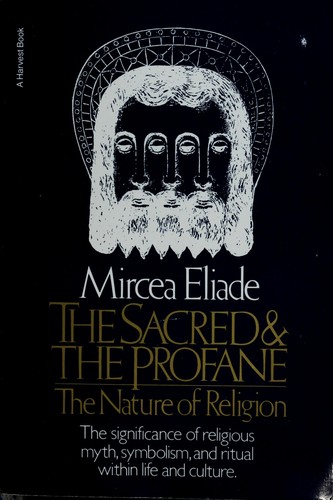
Talk to The Sacred and the Profane like its author wrote you back.
Get the ideas that fit your life — not generic summaries.
- Chat with the book
- Audiobook-style main ideas
- Adapts to your life and goals
- Helps you take action
What it argues
The Sacred and the Profane is Mircea Eliade's most accessible introduction to his life's central argument: that religious experience is a distinct mode of being in the world, irreducible to sociology, economics, psychology, or any other secular explanatory framework. For religious humanity — which Eliade takes to mean virtually all humans before modernity — the world is not a uniform, neutral space and time but a differentiated cosmos in which certain places, moments, and objects are charged with sacred power while others remain ordinary, profane.
Eliade develops this argument through four categories. Sacred space is not homogeneous: there is a center, an axis mundi where heaven, earth, and the underworld meet, and there is the undifferentiated space around it. Sacred time is cyclical rather than linear: festivals and rituals do not commemorate past events but participate in them, making them present again. This is why myth — the account of what happened "in the beginning" — is not fiction but the most real form of narrative: it establishes the patterns that ordinary life imitates. Eliade then extends the analysis to nature and human existence itself, arguing that for religious humanity the entire natural world — sun, water, earth, vegetation — carries symbolic depth unavailable to modern secular experience.
What it gets right
- 1.
The sacred and the profane are two modes of being in the world, not merely two categories of objects. For religious humanity, the entire cosmos is qualitatively differentiated.
- 2.
Sacred space is centered: there is an axis mundi — a cosmic pillar or mountain or temple — that connects the realms and gives orientation. Without it, space is disorienting and homeless.
- 3.
Sacred time is cyclical and recoverable. Religious ritual does not commemorate the past but makes it present again, allowing participants to inhabit the original sacred moment.
What it covers
Who wrote it
Mircea Eliade (1907–1986) was a Romanian-born historian of religions and philosopher whose work shaped the academic study of religion in the twentieth century. He taught at the University of Chicago from 1956 until his death and edited the sixteen-volume Encyclopedia of Religion. His major scholarly works include Shamanism, Yoga: Immortality and Freedom, and A History of Religious Ideas. The Sacred and the Profane, originally published in German in 1957, is a condensed introduction to the themes he developed at length in his longer studies. His work has been criticized for political associations in his youth and for sweeping comparative claims that later scholars have contested.
