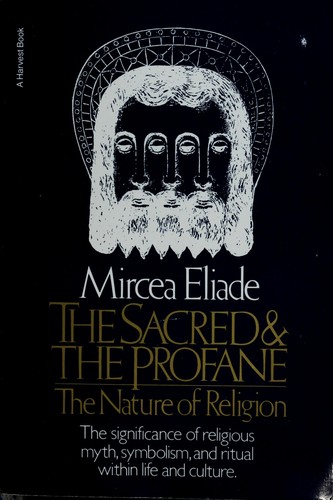
Talk to The Sacred and the Profane like its author wrote you back.
Get the ideas that fit your life — not generic summaries.
- Chat with the book
- Audiobook-style main ideas
- Adapts to your life and goals
- Helps you take action
The Sacred and the Profane, in detail
The Sacred and the Profane is Mircea Eliade's most accessible introduction to his life's central argument: that religious experience is a distinct mode of being in the world, irreducible to sociology, economics, psychology, or any other secular explanatory framework. For religious humanity — which Eliade takes to mean virtually all humans before modernity — the world is not a uniform, neutral space and time but a differentiated cosmos in which certain places, moments, and objects are charged with sacred power while others remain ordinary, profane.
Eliade develops this argument through four categories. Sacred space is not homogeneous: there is a center, an axis mundi where heaven, earth, and the underworld meet, and there is the undifferentiated space around it. Sacred time is cyclical rather than linear: festivals and rituals do not commemorate past events but participate in them, making them present again. This is why myth — the account of what happened "in the beginning" — is not fiction but the most real form of narrative: it establishes the patterns that ordinary life imitates. Eliade then extends the analysis to nature and human existence itself, arguing that for religious humanity the entire natural world — sun, water, earth, vegetation — carries symbolic depth unavailable to modern secular experience.
The book's implicit argument is critical of modernity. The modern desacralized human, Eliade suggests, has not escaped the sacred so much as relocated it in degraded forms — in the cult of celebrity, in political mythology, in the felt significance of certain places and moments that can no longer be named as religious. The nostalgia is not for specific religious beliefs but for the mode of existence that made the world meaningful.
Eliade's scholarship is sweeping and has been criticized for overgeneralization and selective use of sources. But as a framework for thinking about what is lost in secular modernity and what persistent structures of meaning the human animal seems to require, The Sacred and the Profane remains a landmark work in religious studies and comparative religion.
The big ideas
- 1.
The sacred and the profane are two modes of being in the world, not merely two categories of objects. For religious humanity, the entire cosmos is qualitatively differentiated.
- 2.
Sacred space is centered: there is an axis mundi — a cosmic pillar or mountain or temple — that connects the realms and gives orientation. Without it, space is disorienting and homeless.
- 3.
Sacred time is cyclical and recoverable. Religious ritual does not commemorate the past but makes it present again, allowing participants to inhabit the original sacred moment.
