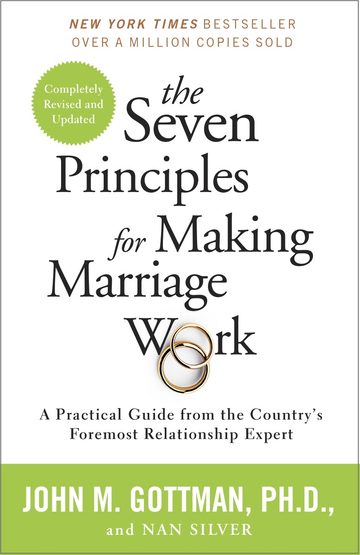
Talk to The Seven Principles for Making Marriage Work like its author wrote you back.
Get the ideas that fit your life — not generic summaries.
- Chat with the book
- Audiobook-style main ideas
- Adapts to your life and goals
- Helps you take action
What it argues
John Gottman is a research psychologist who spent decades studying couples in his "Love Lab" at the University of Washington, filming interactions and measuring physiological responses, and developing a predictive model of relationship outcomes. His claim — that he can predict whether a couple will divorce with around 90 percent accuracy after watching them interact for a few minutes — is based on identifying specific patterns: contempt, criticism, defensiveness, and stonewalling, which he calls the "Four Horsemen" of relationship dissolution. The Seven Principles for Making Marriage Work is his account of what the research says, written for a general audience.
The book's structure moves from diagnosis to prescription. The diagnostic section explains what the research identifies as the markers of relationships in trouble: the ratio of positive to negative interactions (Gottman's "magic ratio" of 5:1 positives to negatives for stable relationships), the difference between criticism and complaint, the corrosive effect of contempt above all other patterns, and the role of physiological flooding — when one or both partners becomes so emotionally overwhelmed that rational conversation becomes impossible. These aren't abstract concepts; Gottman illustrates them with transcribed exchanges that make the patterns immediately recognizable.
What it gets right
- 1.
Contempt is the single most corrosive pattern in relationships — more predictive of divorce than criticism, defensiveness, or conflict frequency. It signals a fundamental loss of respect.
- 2.
The ratio of positive to negative interactions matters more than the absence of conflict. Stable couples have roughly five positive interactions for every negative one, not zero negative ones.
- 3.
Criticism attacks the person; complaint addresses the behavior. The distinction sounds simple but is difficult to maintain under emotional pressure, and the difference in effect is large.
What it covers
Who wrote it
John Gottman is a psychologist and professor emeritus at the University of Washington who spent more than four decades studying couples and developing a research-based model of relationship stability and dissolution. He co-founded the Gottman Institute with his wife and collaborator Julie Gottman, which trains therapists and provides relationship education programs. His research has been widely cited in academic psychology and has been influential in couples therapy practice. Nan Silver is a journalist and author who has collaborated with Gottman on several books translating his research for general audiences, including Why Marriages Succeed or Fail and What Makes Love Last.
