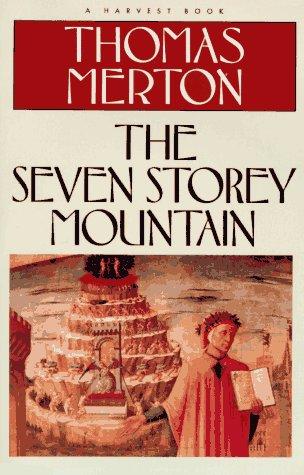
Talk to The Seven Storey Mountain like its author wrote you back.
Get the ideas that fit your life — not generic summaries.
- Chat with the book
- Audiobook-style main ideas
- Adapts to your life and goals
- Helps you take action
What it argues
The Seven Storey Mountain is Thomas Merton's autobiography, published in 1948 when he was thirty-three years old. It covers his life from birth in France in 1915 through his early years in England, New York, and Cambridge, his conversion to Catholicism while a student at Columbia University, and his eventual entry into the Trappist Abbey of Gethsemani in Kentucky in December 1941. The title refers to Dante's Mount Purgatory, which has seven terraces corresponding to the seven deadly sins — Merton sees his own life as a slow ascent toward God.
The book became an unlikely bestseller. Published just after World War II, it spoke to a generation exhausted by violence and ideology, offering a narrative of interior transformation rather than social achievement. Merton writes with a combination of intellectual sharpness and emotional openness that was rare in Catholic writing of the time. He is hard on himself, particularly about his years at Cambridge, and equally hard on the secular intellectual culture he came from, though the critique is affectionate rather than superior.
What it gets right
- 1.
Merton's conversion was intellectual before it was emotional. He came to the Catholic Church through reading — Augustine, Gilson, Maritain — and only then felt the emotional reality of what he had already accepted intellectually.
- 2.
The book argues, implicitly, that the secular intellectual life is not spiritually neutral. Merton's years at Cambridge and early Columbia are depicted as a kind of spiritual dissolution masquerading as freedom.
- 3.
Monastic vocation, as Merton describes it, is not escape but clarification. The monastery narrows life radically in order to deepen it, trading breadth of experience for depth of attention.
What it covers
Who wrote it
Thomas Merton (1915–1968) was an American Catholic monk, poet, and social critic who entered the Trappist Abbey of Gethsemani in Kentucky in 1941. His autobiography The Seven Storey Mountain, published in 1948, became an unexpected bestseller and brought thousands of readers to Christian monasticism. Over the following two decades he published more than sixty books on contemplation, social justice, nonviolence, and interfaith dialogue. He corresponded with figures including D.T. Suzuki, Thich Nhat Hanh, and the Dalai Lama. He died in Bangkok in 1968 while attending an interfaith conference.
