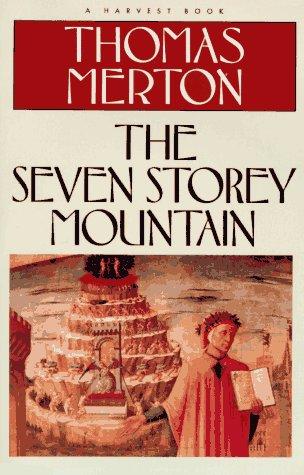
The Seven Storey Mountain by Thomas Merton is a 1948 memoir book about conversion, vocation, identity. Merton's conversion was intellectual before it was emotional. He came to the Catholic Church through reading — Augustine, Gilson, Maritain — and only then felt the emotional reality of what he had already accepted intellectually.
Summary
The Seven Storey Mountain is Thomas Merton's autobiography, published in 1948 when he was thirty-three years old. It covers his life from birth in France in 1915 through his early years in England, New York, and Cambridge, his conversion to Catholicism while a student at Columbia University, and his eventual entry into the Trappist Abbey of Gethsemani in Kentucky in December 1941. The title refers to Dante's Mount Purgatory, which has seven terraces corresponding to the seven deadly sins — Merton sees his own life as a slow ascent toward God.
The book became an unlikely bestseller. Published just after World War II, it spoke to a generation exhausted by violence and ideology, offering a narrative of interior transformation rather than social achievement. Merton writes with a combination of intellectual sharpness and emotional openness that was rare in Catholic writing of the time. He is hard on himself, particularly about his years at Cambridge, and equally hard on the secular intellectual culture he came from, though the critique is affectionate rather than superior.
The Columbia section is the book's most lively. Merton depicts a world of competing ideas — Communism, existentialism, Thomistic philosophy — as he moves toward the Catholic Church. His baptism is not a sudden conversion but the culmination of years of reading, conversation, and what he describes as a growing inability to find meaning in any other framework. The decision to enter the monastery follows naturally from the logic of the conversion: if God is real and available, why do anything else?
The final section, inside the abbey, is the strangest part of the book to modern readers. Merton describes the monastic schedule, the silence, the liturgy, the physical work, with an enthusiasm that has more in common with falling in love than with religion as most people experience it. He is aware this sounds excessive. He is also aware it was not a mistake. The Seven Storey Mountain is the record of a man who found exactly what he was looking for, and is honest enough to acknowledge that most people find that implausible.
Talk to The Seven Storey Mountain like its author wrote you back.
Get the ideas that fit your life — not generic summaries.
- Chat with the book
- Audiobook-style main ideas
- Adapts to your life and goals
- Helps you take action
Key takeaways
- 1.
Merton's conversion was intellectual before it was emotional. He came to the Catholic Church through reading — Augustine, Gilson, Maritain — and only then felt the emotional reality of what he had already accepted intellectually.
- 2.
The book argues, implicitly, that the secular intellectual life is not spiritually neutral. Merton's years at Cambridge and early Columbia are depicted as a kind of spiritual dissolution masquerading as freedom.
- 3.
Monastic vocation, as Merton describes it, is not escape but clarification. The monastery narrows life radically in order to deepen it, trading breadth of experience for depth of attention.
- 4.
The Seven Storey Mountain helped define mid-century American Catholicism. Its influence on seminary enrollment and lay religious life in the 1950s was measurable and widely documented.
- 5.
Merton is candid about failure, including an illegitimate child he fathered at Cambridge whose fate he spent years trying to determine. The candor distinguishes the book from pious hagiography.
- 6.
The Columbia intellectual community — including Mark Van Doren, Robert Lax, and Edward Rice — forms a kind of secular monastery in the book. Merton's friendships there foreshadow what he will find in religious community.
- 7.
The figure of Dan Walsh, the philosophy teacher who introduced Merton to Thomism and later became a priest himself, exemplifies the book's argument that transformation usually passes through a particular person.
- 8.
Merton's enthusiasm for monastic life is genuine but not naive. He acknowledges the difficulty, the boredom, the dark periods. The joy is not despite those things but interwoven with them.
Discussion questions
Use these on your own, with a book club, or as chat starters in Superbook. Book club version, ready to copy or print →
- 1.
Merton describes his years at Cambridge as a period of damage disguised as liberation. Have you had periods in your life that only looked clearly like what they were from a distance?
- 2.
His path to conversion ran through books rather than community or spiritual experience. What does that suggest about the different ways people come to religious commitment?
- 3.
Merton leaves out much of what happened at Cambridge — a lost child, a broken engagement — but alludes to it. How does partial transparency work in a memoir that presents itself as a full spiritual account?
- 4.
The book was a bestseller in 1948. What does it tell us that a detailed account of a man entering a silent monastery was the publishing event it was in postwar America?
- 5.
Merton's conversion involves leaving behind specific intellectual commitments — Communism, secular humanism — not just finding a new faith. Is conversion always a leaving, not just an arriving?
- 6.
He describes his Columbia friendships as proto-monastic in quality. Have you had friendships that functioned as a kind of community with shared values strong enough to shape you?
- 7.
Merton is hard on himself but not self-pitying. Is there a difference between those two things, and how do you recognize it in a memoir?
- 8.
He argues that the contemplative life is the most productive thing a human being can do with their existence. Do you find that argument coherent or absurd?
- 9.
The Seven Storey Mountain ends before Merton's mature thought — before his engagement with civil rights, his Zen studies, his later theological development. Does knowing what came after change how you read the early certainties?
- 10.
Merton chose a life of radical constraint. What constraints in your own life have clarified rather than limited your experience?
- 11.
He is clear that the decision to become a monk came with the understanding that he was likely giving up writing. The writing career that followed was unexpected. What does that reversal suggest about plans made at moments of deep commitment?
- 12.
If you were writing the spiritual autobiography of your own life to date, what would be its organizing structure?
Themes
Frequently asked questions
-
Is The Seven Storey Mountain worth reading today?
Yes, even for readers without religious interest. As a memoir of intellectual conversion and the search for meaning, it remains compelling. The prose is excellent, Merton is hard on himself, and the Columbia section reads as a genuine portrait of mid-century American intellectual life.
-
How long is The Seven Storey Mountain?
Approximately 462 pages in most editions. At average reading pace, expect around nine to ten hours. The book is long but Merton's prose carries it — it rarely drags.
-
Do I need to be Catholic to get something from this book?
No. The theological content is present throughout, but the book's structure — a person trying and failing to find meaning until they find it — is accessible to any reader. The interest is as much psychological and intellectual as religious.
-
What is the difference between The Seven Storey Mountain and New Seeds of Contemplation?
The Seven Storey Mountain is a narrative autobiography, covering Merton's life through his entry into the monastery. New Seeds of Contemplation is a meditative, essay-form exploration of the contemplative life itself. They are complementary but very different books.
-
Why is it called The Seven Storey Mountain?
The title refers to Dante's Mount Purgatory in the Divine Comedy, which has seven terraces corresponding to the seven deadly sins. Merton saw his own spiritual development as a purgatorial ascent — a movement through sin and disorder toward union with God.