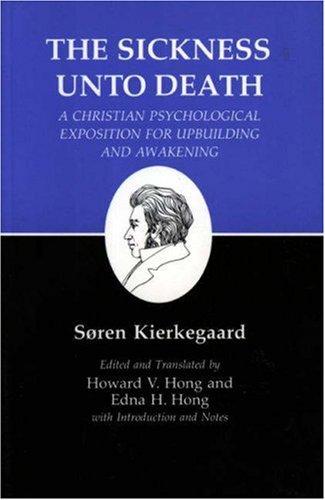
Talk to The Sickness Unto Death like its author wrote you back.
Get the ideas that fit your life — not generic summaries.
- Chat with the book
- Audiobook-style main ideas
- Adapts to your life and goals
- Helps you take action
What it argues
The Sickness Unto Death, published in 1849 under the pseudonym Anti-Climacus, is Kierkegaard's most rigorous psychological and theological analysis of despair — which he defines not as an emotion but as a structural failure of selfhood. The title comes from the Gospel of John (the story of Lazarus), but Kierkegaard reinterprets the sickness unto death as despair: a condition from which there is no exit except through faith, and which can be fatal to the spirit even while the body survives.
The opening definition is one of the most demanding in the entire philosophical tradition: a human being is a synthesis of the infinite and the finite, the temporal and the eternal, freedom and necessity. The self is the relationship between these poles — not one of the poles but the relational activity itself. Despair arises when this relationship fails: when the self either loses itself in the finite (failing to become itself) or exhausts itself in abstraction from the finite (also failing to become itself). Both failures are forms of despair, and the person in either form is not at rest in the relationship that they are.
What it gets right
- 1.
Despair is not an emotion but a structural failure of selfhood: the self failing to be what it is constituted to be, in relation to the power that establishes it.
- 2.
A human being is a synthesis of infinite and finite, temporal and eternal, freedom and necessity; the self is the relational activity between these poles.
- 3.
The most common and most dangerous form of despair is unconscious — the person does not know they are in despair and calls it contentment.
What it covers
Who wrote it
Søren Kierkegaard (1813–1855) was a Danish philosopher and theologian, born in Copenhagen into a wealthy and deeply religious family marked by his father's sense of divine punishment. Writing prolifically under numerous pseudonyms to explore different stages of existence, he produced works including Either/Or, Repetition, Fear and Trembling, Philosophical Fragments, and The Sickness Unto Death over barely a decade. His insistence on subjective truth, individual existence, and the irreducibility of genuine faith made him the progenitor of 20th-century existentialism. He died after collapsing in a street in Copenhagen at age 42.
