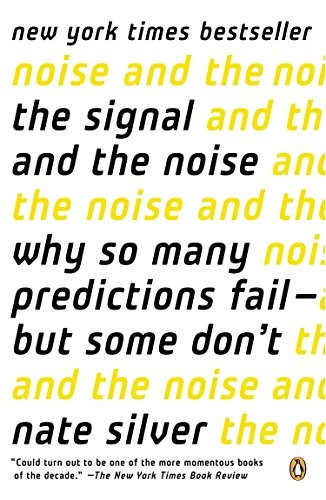
Talk to The Signal and the Noise like its author wrote you back.
Get the ideas that fit your life — not generic summaries.
- Chat with the book
- Audiobook-style main ideas
- Adapts to your life and goals
- Helps you take action
What it argues
Nate Silver made his reputation predicting baseball statistics and then political elections. This book is his attempt to explain why some predictions succeed and most fail — and what separates the two. The title captures his central distinction: signal is the true pattern you're trying to find; noise is everything else that misleads you into thinking you've found something you haven't.
Silver works through a dozen domains: weather forecasting, earthquake prediction, economic models, epidemics, chess, poker, the stock market, and political punditry. Each domain reveals a different failure mode. Economists build models that fit past data beautifully but forecast poorly because they mistake correlation for understanding. Political pundits claim certainty they don't have because certainty is more engaging than honest probability. Seismologists can't predict individual earthquakes because the underlying system is genuinely chaotic. The book uses these cases not as gotchas but as lessons — each failed prediction teaches something about the structure of uncertainty.
What it gets right
- 1.
Most predictions fail because forecasters confuse noise for signal — mistaking random fluctuation for meaningful pattern in their data.
- 2.
Bayesian reasoning means updating your beliefs proportionally as new evidence arrives, never treating any belief as certain and never treating any evidence as definitive.
- 3.
Calibration matters more than confidence. A forecaster who says '70% likely' and is right 70% of the time is more useful than one who says 'certain' and is right 60% of the time.
What it covers
Who wrote it
Nate Silver is a statistician and writer best known for founding FiveThirtyEight, a data journalism website focused on elections, sports, and economics. He first gained wide attention by correctly forecasting 49 of 50 states in the 2008 U.S. presidential election using a statistical model. Silver's background is in sabermetrics — the application of statistical analysis to baseball — which he developed into the PECOTA forecasting system before turning to political prediction. He is a leading advocate for probabilistic communication in journalism and public affairs.
