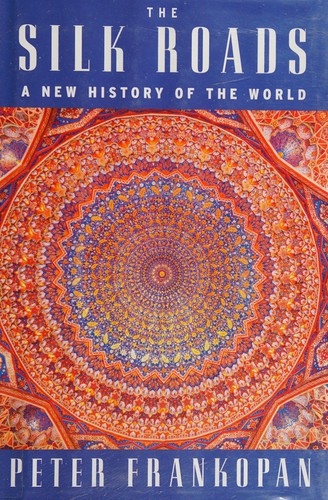
Talk to The Silk Roads: A New History of the World like its author wrote you back.
Get the ideas that fit your life — not generic summaries.
- Chat with the book
- Audiobook-style main ideas
- Adapts to your life and goals
- Helps you take action
The Silk Roads: A New History of the World, in detail
Peter Frankopan's The Silk Roads proposes a radical recentering of world history. The conventional Western narrative places Europe — Greece, Rome, the Renaissance, the Scientific Revolution, the Industrial Revolution — at the center of the story. Frankopan argues this is a parochial distortion. For most of recorded history, the great flows of goods, ideas, religion, and power moved along the routes connecting Central Asia, Persia, Mesopotamia, the Indian subcontinent, and China. The spine of civilization, he argues, was the Silk Roads — a network of overland and maritime trade routes that linked these regions for millennia before European maritime empires disrupted and eventually dominated them.
The book begins not in Athens or Rome but in Persia, tracing the Persian Empire's central role as a connector of the ancient world. It then follows the diffusion of Buddhism and later Islam along trade routes, the material basis of the Islamic Golden Age, the Mongol Empire as a brief but transformative force for cross-continental exchange, and the devastating disruptions wrought by plague and climate. Frankopan is particularly strong on the medieval period, where Central Asia and the Middle East were the centers of wealth, learning, and power while Europe was a peripheral backwater trading furs and slaves.
The narrative accelerates through the early modern and modern periods, following European commercial penetration of Asia, the emergence of British India, the discovery of oil, the Great Game between Britain and Russia over Central Asia, and the twentieth century's oil-driven geopolitics. Frankopan argues that the Iraq Wars, the war in Afghanistan, and the contemporary rivalry between the United States and China all make more sense when you understand that the lands at the center of the Silk Roads have been the objects of external competition for centuries.
The book's great strength is the range and ambition of its reframing. Its weakness is unevenness: some chapters are more thoroughly documented than others, and the pace of the narrative means that complex periods are compressed into a few pages. As a corrective to Eurocentrism in world history education, it succeeds admirably. As a definitive synthesis, it leaves significant gaps. Frankopan writes well and the argument is genuinely illuminating even where the evidence is selective.
The big ideas
- 1.
The conventional Eurocentric narrative of world history misrepresents where civilization's centers of wealth, learning, and power actually were for most of recorded time.
- 2.
The Silk Roads were not just trade routes for silk; they were the channels through which religion, disease, technology, and political ideas moved between continents.
- 3.
Central Asia, Persia, and the Middle East were the world's economic and cultural cores during Europe's medieval period. Europe was then the periphery, not the center.
