The Silk Roads: A New History of the World by Peter Frankopan is a 2015 history book about world history, trade and exchange, geopolitics. The conventional Eurocentric narrative of world history misrepresents where civilization's centers of wealth, learning, and power actually were for most of recorded time.
Summary
Peter Frankopan's The Silk Roads proposes a radical recentering of world history. The conventional Western narrative places Europe — Greece, Rome, the Renaissance, the Scientific Revolution, the Industrial Revolution — at the center of the story. Frankopan argues this is a parochial distortion. For most of recorded history, the great flows of goods, ideas, religion, and power moved along the routes connecting Central Asia, Persia, Mesopotamia, the Indian subcontinent, and China. The spine of civilization, he argues, was the Silk Roads — a network of overland and maritime trade routes that linked these regions for millennia before European maritime empires disrupted and eventually dominated them.
The book begins not in Athens or Rome but in Persia, tracing the Persian Empire's central role as a connector of the ancient world. It then follows the diffusion of Buddhism and later Islam along trade routes, the material basis of the Islamic Golden Age, the Mongol Empire as a brief but transformative force for cross-continental exchange, and the devastating disruptions wrought by plague and climate. Frankopan is particularly strong on the medieval period, where Central Asia and the Middle East were the centers of wealth, learning, and power while Europe was a peripheral backwater trading furs and slaves.
The narrative accelerates through the early modern and modern periods, following European commercial penetration of Asia, the emergence of British India, the discovery of oil, the Great Game between Britain and Russia over Central Asia, and the twentieth century's oil-driven geopolitics. Frankopan argues that the Iraq Wars, the war in Afghanistan, and the contemporary rivalry between the United States and China all make more sense when you understand that the lands at the center of the Silk Roads have been the objects of external competition for centuries.
The book's great strength is the range and ambition of its reframing. Its weakness is unevenness: some chapters are more thoroughly documented than others, and the pace of the narrative means that complex periods are compressed into a few pages. As a corrective to Eurocentrism in world history education, it succeeds admirably. As a definitive synthesis, it leaves significant gaps. Frankopan writes well and the argument is genuinely illuminating even where the evidence is selective.
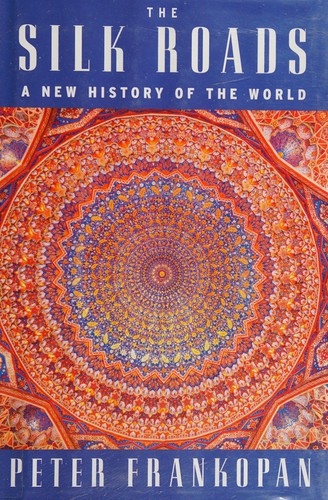
Talk to The Silk Roads: A New History of the World like its author wrote you back.
Get the ideas that fit your life — not generic summaries.
- Chat with the book
- Audiobook-style main ideas
- Adapts to your life and goals
- Helps you take action
Key takeaways
- 1.
The conventional Eurocentric narrative of world history misrepresents where civilization's centers of wealth, learning, and power actually were for most of recorded time.
- 2.
The Silk Roads were not just trade routes for silk; they were the channels through which religion, disease, technology, and political ideas moved between continents.
- 3.
Central Asia, Persia, and the Middle East were the world's economic and cultural cores during Europe's medieval period. Europe was then the periphery, not the center.
- 4.
The Mongol Empire, despite its destructiveness, created a period of cross-continental exchange — the Pax Mongolica — that transmitted goods, ideas, and disease at unprecedented scale.
- 5.
The Black Death, which arrived in Europe along the Silk Roads, is a reminder that global connectivity has always transmitted catastrophe alongside prosperity.
- 6.
The discovery of oil in the Persian Gulf and Central Asia in the twentieth century returned those regions to their historic position as the axis of global competition.
- 7.
Understanding contemporary conflicts in Iraq, Afghanistan, and Central Asia requires a long historical view of why external powers have always competed for control of these routes.
- 8.
China's Belt and Road Initiative, launched after this book was published, represents an attempt to revive and control the historic Silk Roads — a direct continuation of the pattern Frankopan traces.
Discussion questions
Use these on your own, with a book club, or as chat starters in Superbook. Book club version, ready to copy or print →
- 1.
Frankopan argues Europe was a peripheral backwater for most of medieval history. Does that framing change how you think about the Renaissance and its significance?
- 2.
He centers Persia and Central Asia in the ancient world. What do you know about those civilizations independently of this book, and does Frankopan's treatment feel fair?
- 3.
The Silk Roads carried religion as well as goods. How does the trade-driven diffusion of Buddhism and Islam change how you think about those religions' universalism?
- 4.
The Mongol Empire appears here as a facilitator of exchange as much as a destructive force. How should historians balance those two aspects?
- 5.
The Black Death traveled the Silk Roads. What does it mean for our understanding of globalization that its worst consequences have always been epidemiological as much as economic?
- 6.
Frankopan argues that oil replaced silk as the commodity organizing geopolitical competition. What commodity might play that role in the next century?
- 7.
The book's title — 'A New History of the World' — is an ambitious claim. Did it deliver something genuinely new to you, or does the reframing feel overstated?
- 8.
Which chapter or period did you find most surprising, and why?
- 9.
Frankopan is more convincing on the ancient and medieval periods than on the modern. Did you notice the unevenness, and does it affect your overall assessment?
- 10.
He ends with China's growing economic presence in Central Asia and Africa. Does the book's historical frame help you understand that development?
- 11.
What does this book suggest about the relationship between geography and historical destiny?
- 12.
If you had to assign a core textbook for a world history course, would The Silk Roads be a better choice than a conventional Western-centered narrative? Why or why not?
Themes
Frequently asked questions
-
Is The Silk Roads worth reading?
Yes, particularly if your historical education was primarily Eurocentric. The reframing is genuinely illuminating, and Frankopan writes with enough momentum to keep a long book moving. The medieval chapters are the strongest; some modern chapters feel rushed.
-
How long does it take to read The Silk Roads?
About 13 to 15 hours at average reading pace for the roughly 500-page text. The chapters are organized by era rather than place, which makes it easy to dip into specific periods, but the full argument benefits from reading sequentially.
-
What does the title mean? Are the Silk Roads literal roads?
Partly. The historical Silk Roads included both overland routes through Central Asia and maritime routes across the Indian Ocean and Persian Gulf. Frankopan uses the term broadly to mean the whole network of exchange that connected Asia, the Middle East, and eventually Europe — commerce as much as geography.
-
Is this book academic or accessible to general readers?
It is written for general readers, not specialists. Frankopan avoids jargon and moves quickly through long periods of time. Specialists in particular eras will find the treatment selective, but as a broad narrative it is accessible and engaging.
-
How does The Silk Roads compare to Sapiens?
Both are big-history books that challenge conventional narratives. Sapiens is more concerned with deep human prehistory and biological evolution; The Silk Roads focuses on recorded history and the geographic centers of civilizational development. They complement rather than duplicate each other.
Similar books
Sapiens: A Brief History of Humankind
Yuval Noah Harari
Guns, Germs, and Steel
Jared Diamond
The Better Angels of Our Nature
Steven Pinker
Homo Deus: A Brief History of Tomorrow
Yuval Noah Harari
